Intent: compare. A swimming record board is only as trustworthy as the verification workflow behind it—and only as useful as the event structure it organizes records into.
Every school with a swim program eventually confronts the same challenge: individual events, relay combinations, and dual-gender record categories generate a volume of entries that quickly outgrows a hand-lettered board on the natatorium wall. When a swimmer breaks the 100-yard butterfly record in November, how long before that name appears on the display? Who verifies the time against the official meet sheet? What happens to the previous record holder—is their name preserved somewhere, or does it simply get painted over?
These questions aren’t administrative trivia. They define whether a swimming record board functions as a reliable program archive or an aspirational wall decoration that coaches stop pointing to because it may be wrong. This guide covers how schools should structure swimming event categories on a record board, how relay records differ from individual entries, what a sound verification workflow looks like, and how physical boards compare to digital display alternatives for programs that need both accuracy and sustainability.
A well-organized swimming record board tells the story of a program across decades—every fastest time, every relay team, every record that stood for years before a new class arrived and chased it down. Getting that structure right from the start makes every future update faster, more accurate, and less prone to the data errors that quietly undermine trust in a record display.
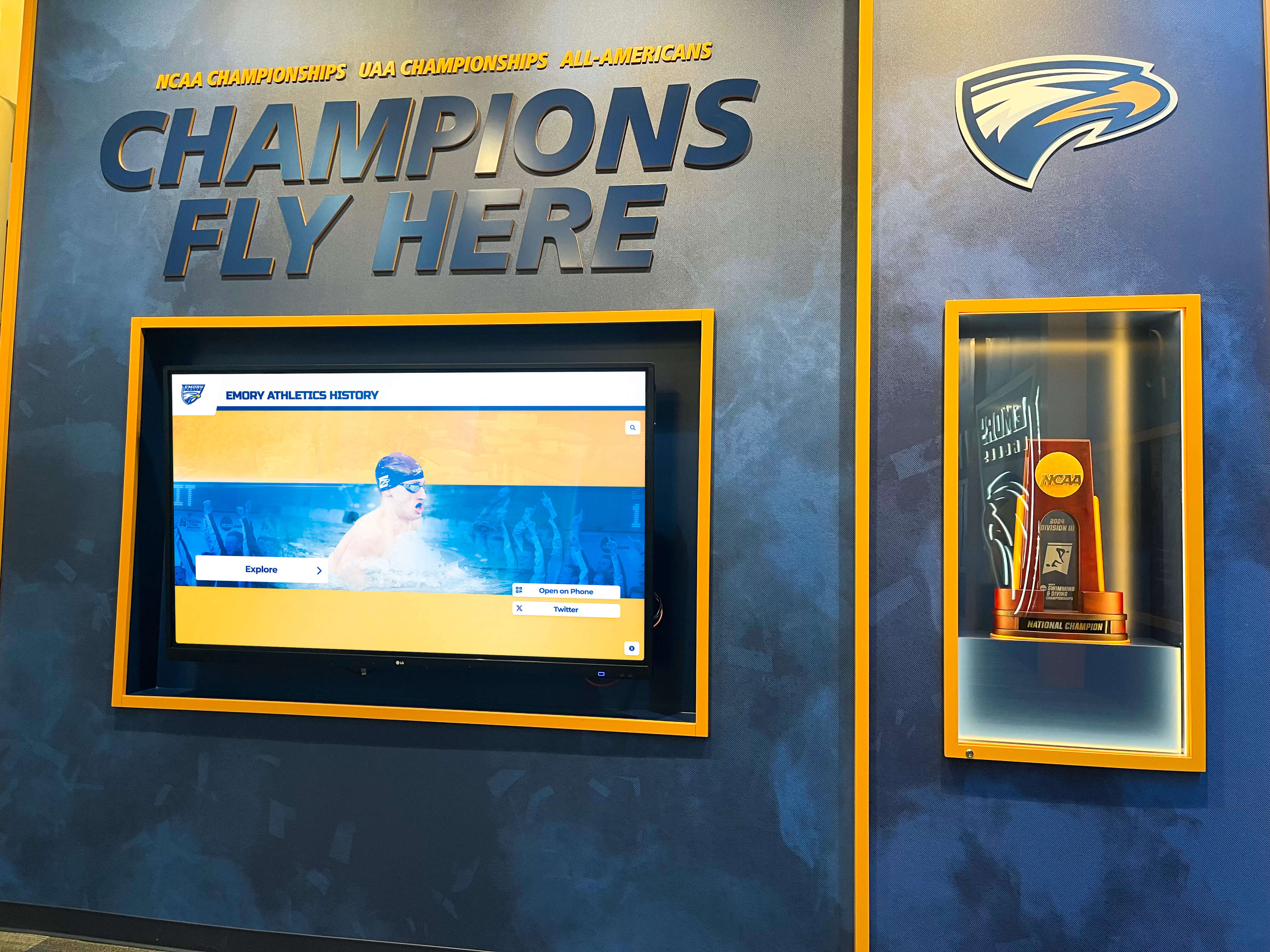
A swimming record board works best when it's embedded in a broader recognition environment—one where records, trophies, and program history share the same dedicated space
How Schools Typically Structure Swimming Events on a Record Board
High school and collegiate swim programs share similar event menus, making the record board structure fairly consistent across institutions. The standard individual events recognized on a competitive swimming record board follow the event menu set by the National Federation of State High School Associations (NFHS) for high school programs, or NCAA guidelines at the collegiate level.
Individual Event Categories
A complete school swimming record board typically covers individual events across all four competitive strokes, individual medley, and freestyle distances:
Freestyle
- 50-yard Freestyle
- 100-yard Freestyle
- 200-yard Freestyle
- 500-yard Freestyle
- 1000-yard Freestyle (where contested)
- 1650-yard Freestyle (collegiate)
Backstroke
- 100-yard Backstroke
- 200-yard Backstroke
Breaststroke
- 100-yard Breaststroke
- 200-yard Breaststroke
Butterfly
- 100-yard Butterfly
- 200-yard Butterfly
Individual Medley
- 200-yard Individual Medley
- 400-yard Individual Medley
Diving (where scored separately from pool events)
- 1-Meter Diving
- 3-Meter Diving (where contested)
Each event category typically requires separate record entries for men’s and women’s programs. Schools running co-ed programs that do not separate by gender will need to define their own categorization scheme and apply it consistently from the first record entered.
For a thorough overview of how schools approach swimming and other athletic record displays with similar event-based structures, this guide to digital swim record boards covers the event organization principles that translate well across multiple sports.
Relay Events: Team Records and the Multi-Swimmer Challenge
Relay records are structurally different from individual records, and that difference creates the biggest administrative complication for any swimming record board.
An individual record has one name, one time, one meet, one date, and one verification source. A relay record has all of those fields—plus four swimmer names, plus the question of which four swimmers swam which legs, plus the challenge of what happens when a relay record is broken by a partial team that includes returning members of the previous record team.
Standard relay events for high school swimming record boards:
Medley Relays
- 200-yard Medley Relay (backstroke, breaststroke, butterfly, freestyle legs)
Freestyle Relays
- 200-yard Freestyle Relay
- 400-yard Freestyle Relay
Each relay record entry should capture: total team time, split times for each leg when available, names of all four swimmers in stroke order, the meet name, meet date, and the season year. Programs that omit split times from relay records create a permanent blind spot in the archive—meet programs and scoresheets that could have provided those splits become harder to locate with each passing year.
Understanding how swimming record boards compare to similar multi-event structures like track record boards is useful context for schools building record-keeping frameworks that span multiple sports programs.
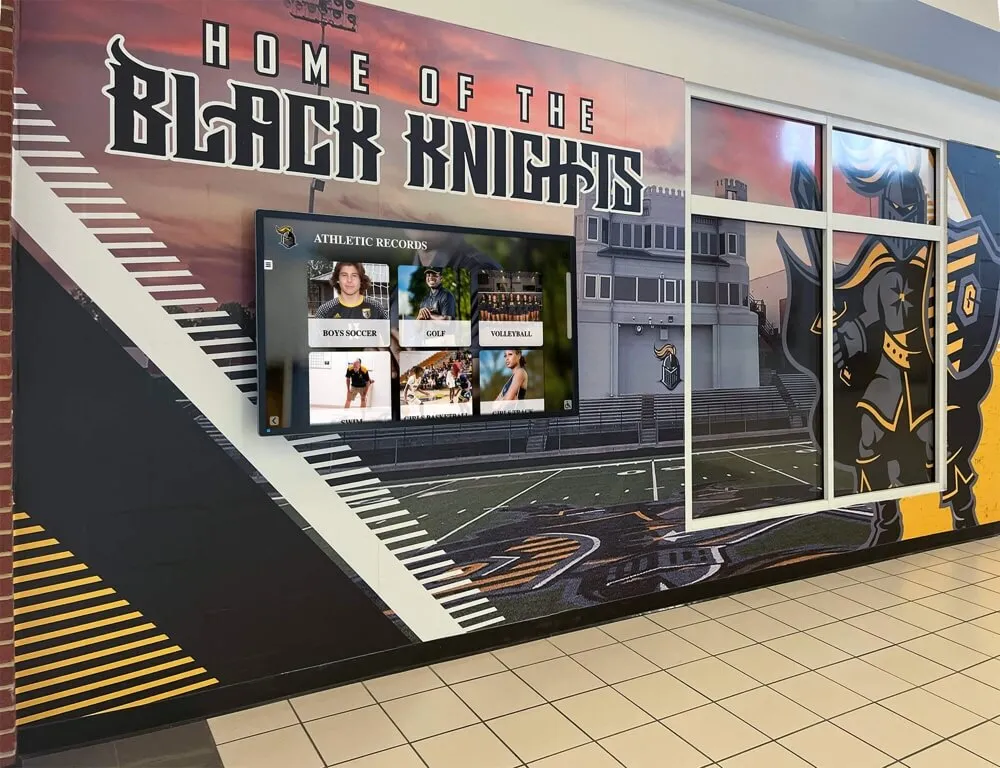
Athletic hallways that integrate record boards with facility identity elements—murals, school colors, mascots—give swimming records the visual context they deserve
Physical Board vs. Touchscreen Digital Display: A Direct Comparison
The format chosen for a swimming record board shapes every workflow that follows it. Schools at the early stages of planning a new record display, or reconsidering an existing one, benefit from comparing format options against the operational realities of a swim program.
| Feature | Physical Painted Board | Static Digital Display | Interactive Touchscreen System |
|---|---|---|---|
| Update process | Professional repainting required | Image file replacement | CMS data entry (minutes) |
| Update cost | $500–$2,500+ per session | Staff time to redesign image | Staff time for data entry |
| Update speed | Weeks (vendor lead time) | Days (design revision) | Same day or next day |
| Relay team names | Space-limited; often abbreviated | Space-limited by image design | Unlimited; full names displayed |
| Split times storage | Rarely included | Rarely included | Included as structured data fields |
| Historical records | Displaced or lost on repaint | Limited by display space | Unlimited archive with full history |
| Search/filter by event | Not possible | Not possible | Yes, tap to navigate by event |
| Gender separation | Visual only | Visual only | Logical separation with filtering |
| Meet context | Often omitted | Often omitted | Meet name, date, season included |
| Photo of athlete | Not possible | Possible with image file | Yes, attached to athlete profile |
| Mobile access (QR) | Not possible | Not possible | Yes, QR code extends reach |
| ADA accessibility | Not applicable | Limited | WCAG 2.1 AA compliance possible |
| Long-term cost | High (recurring repaint cycles) | Medium (design labor) | Lower over 5+ years |
The pattern across this comparison is consistent: physical boards and static digital displays require more effort per update and store less information than interactive systems. For programs with multiple events, relay records, and dual-gender categories—which describes almost every competitive swim team—that difference compounds quickly.
Exploring creative approaches to school athletic record boards provides additional context for schools evaluating which format serves their program’s recognition goals.
The Verification Workflow: From Pool Finish to Record Display
Accuracy on a swimming record board starts with a clear verification protocol, applied consistently regardless of display format. A record that appears on the board without verification damages the credibility of everything displayed alongside it.
Step 1: Performance Identification
The process begins at the meet. Coaches, timers, or designated record-tracking staff compare each swimmer’s official finish time against the current record for that event. This comparison should happen during or immediately after the meet using the official results sheet—not from memory, not from an unofficial timing display.
For relay events, the comparison involves the team time only at this stage. Leg splits, if available from the timing system printout, should be captured at this point because they become unavailable once the meet ends and the printout is no longer accessible.
Step 2: Official Results Documentation
Before any record entry is submitted, the performance must be documented with an official source. Acceptable documentation typically includes:
- Official meet results sheet (signed by the meet referee)
- Timing system printout with event, heat, lane, and official time
- Online results database entries (where used by the sanctioning body)
A new record entry supported only by a coach’s memory or an unofficial phone screenshot does not meet the documentation standard. This matters most for relay records, where the four swimmer names must also be confirmed from the official heat sheet—not from coaching notes.
Verification workflows for track and field record boards follow a similar documentation-first approach and offer parallel guidance useful for athletic departments managing verification across multiple sports.
Step 3: Athletic Director Review and Approval
Verified documentation should pass through an athletic director review before the record is posted to the public display. This review step exists for a specific reason: it catches errors before they become official—a swimmer name misspelled on the heat sheet, a preliminary time posted instead of the finals time, a relay entry with the wrong stroke order.
In most school programs, the athletic director or an appointed designee (an associate athletic director, a senior swim coach) holds approval authority. The approval step should be documented—a date-stamped email or a digital record approval workflow—so there is a clear trail if questions arise later about when a record was officially recognized.
Step 4: Display Update
After approval, the record goes to whoever manages the physical or digital display. For painted boards, this means queueing a repaint with the vendor. For digital systems, it means an authorized staff member logs into the content management system (CMS), navigates to the event record, and enters the new data.
The gap between approval and display update is where most programs lose consistency. A clear internal policy—records approved within 48 hours of a meet, updates posted within 7 days of approval, for example—prevents the quiet accumulation of approved records that exist in an email thread but haven’t appeared on the board.
Step 5: Historical Record Preservation
When a new record is set, the previous record doesn’t disappear. On physical boards, it often does—the name gets painted over, and there is no record that anyone swam that fast. On digital systems, the previous record holder remains in the archive, accessible to anyone who wants to explore how the program’s performance standards have evolved over time.
This archival function is underappreciated until alumni start asking questions: “When was the school record in the 500 freestyle first broken under 5 minutes?” A digital system with full historical records can answer that question. A painted board cannot.
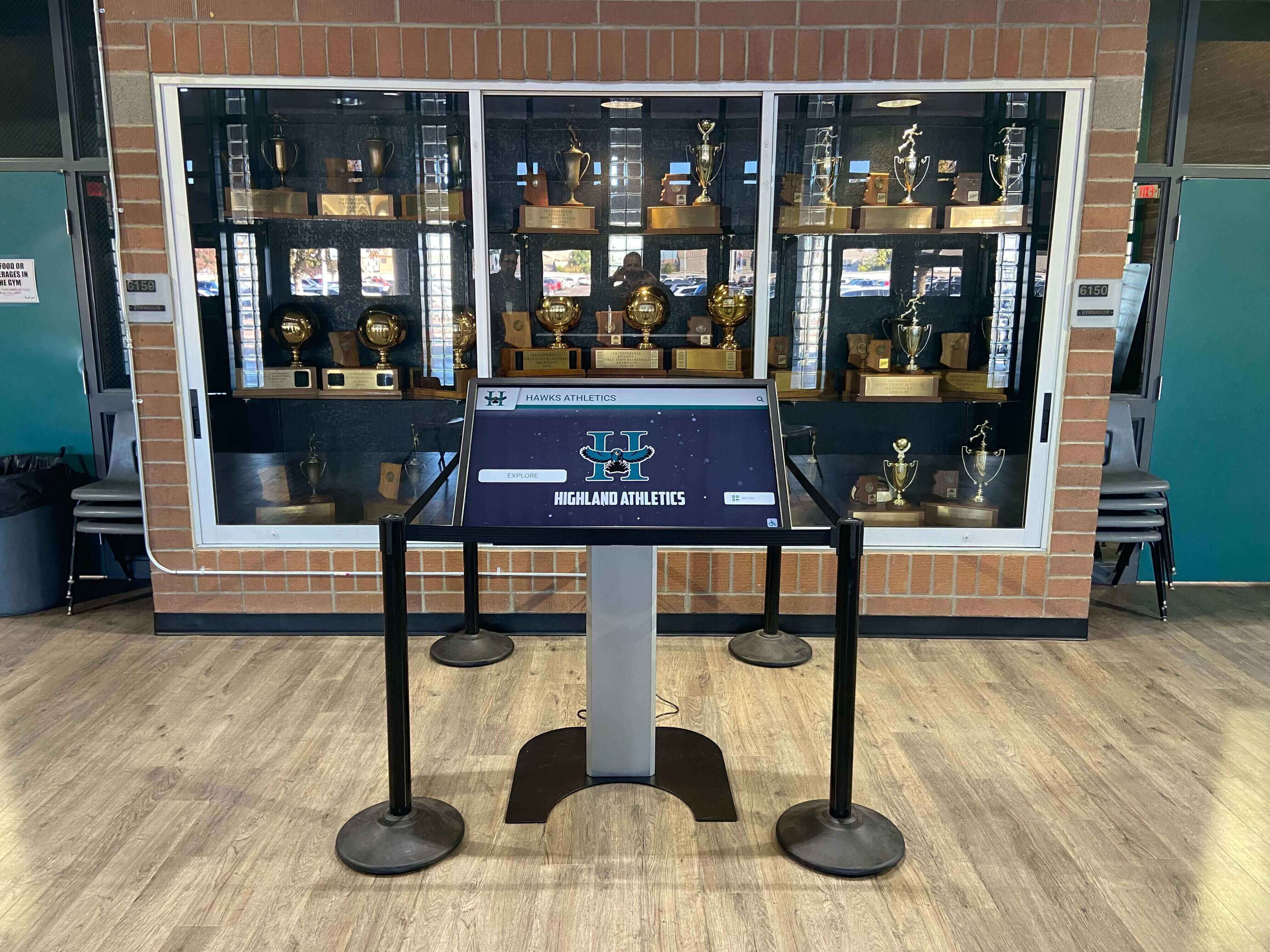
Touchscreen systems installed in trophy case areas make swimming records searchable and browsable—visitors can navigate by event, year, or swimmer name without staff involvement
Data Fields Every Swimming Record Entry Should Include
Regardless of display format, a well-structured swimming record board captures consistent data fields for every entry. The minimum data set for an individual event record:
- Event name (100-yard Backstroke, 200-yard IM, etc.)
- Gender category (Men’s / Women’s / Mixed, if applicable)
- Athlete full name
- Class year at time of record (optional but useful for alumni context)
- Official time (in HH:MM:SS.xx format where applicable)
- Meet name
- Meet date
- Season year
For relay records, additional fields:
- Swimmer 1 name and stroke leg (e.g., Swimmer A — Backstroke)
- Swimmer 2 name and stroke leg
- Swimmer 3 name and stroke leg
- Swimmer 4 name and stroke leg
- Individual leg splits (when available from official timing)
Programs that include class year find that this field becomes increasingly valuable over time—it allows visitors to contextualize records within eras of the program, notice patterns in program strength, and connect records to athletes they may know personally.
Design approaches for athletic record boards across multiple sports address how display layout choices reinforce these data fields in ways visitors can absorb at a glance rather than searching for context.
How Digital Systems Handle the Swimming Verification Workflow
Purpose-built digital record board platforms change the verification workflow in two significant ways: they create a structured data entry path that enforces field completeness, and they enable staged approval before records go public.
Structured Entry Forms
Rather than entering record data into a generic spreadsheet, authorized staff members use event-specific forms within the CMS. The form for a relay event prompts for four swimmer names, stroke assignments, and split times—so a relay entry without all four names isn’t possible to submit. The form for an individual event requires meet name and date, preventing undated entries from accumulating in the archive.
This field enforcement isn’t bureaucratic friction. It’s the mechanism that keeps the record board accurate over years of use by different staff members who may not remember every data standard.
Staging and Approval Workflows
Most purpose-built platforms allow records to be entered in a draft state—visible to authorized CMS users but not yet displayed to the public. The athletic director reviews the draft entry, confirms the documentation, and approves publication. Only then does the record appear on the public-facing touchscreen.
This staging workflow doesn’t require a separate email chain or paper approval process. Everything happens inside the platform, with a built-in audit trail showing who entered the record, who approved it, and when each action occurred.
Maintaining athletic record boards over time becomes significantly simpler when the platform enforces data standards and maintains audit trails that physical boards cannot provide.
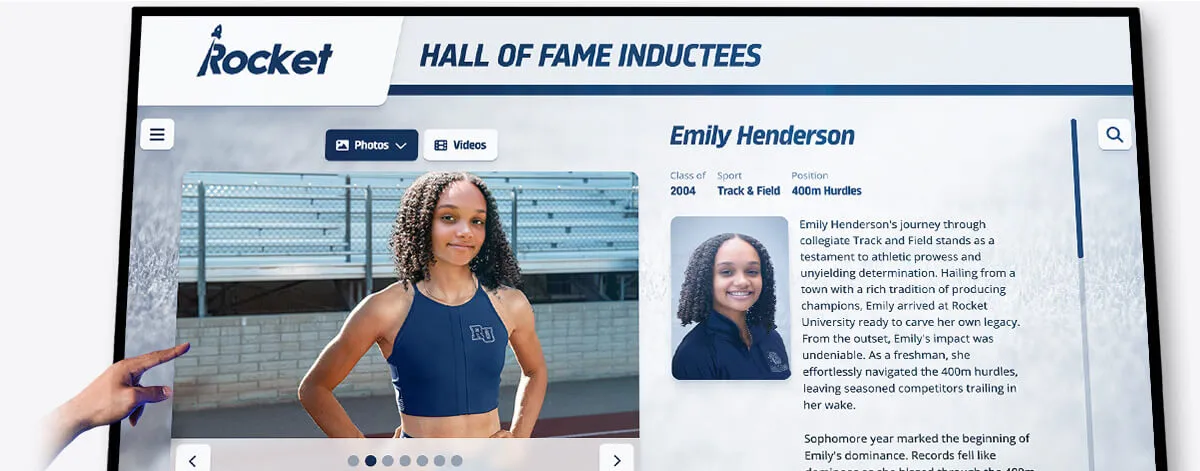
Digital record board platforms display individual athlete records alongside profile photos and career context—giving swimming records the biographical depth that painted boards cannot accommodate
Displaying Swimming Records Alongside Broader Athletic Recognition
A swimming record board exists within a recognition environment—the natatorium, the athletic hallway, the trophy case area that visitors pass when entering for a meet. The most effective installations treat the record board not as a standalone element but as one component in a unified athletic recognition space.
That integration creates natural opportunities. A swimmer who holds a school record may also be a hall of fame inductee. A relay team that broke a record in a championship meet may have photographs from that event worth displaying alongside the record entry. These connections don’t exist on a painted board. They do exist on a platform that links record entries to athlete profiles, team histories, and event archives.
Schools exploring how to display athletic records, team histories, and individual accomplishments within a single coherent environment benefit from reviewing creative display approaches for school athletic programs that treat recognition as a holistic facility investment rather than a collection of separate displays.
For programs that want to celebrate both athletic and academic achievement in adjacent spaces, school sports bulletin board approaches offer additional context for how schools balance multiple recognition categories within the same hallway or lobby environment.
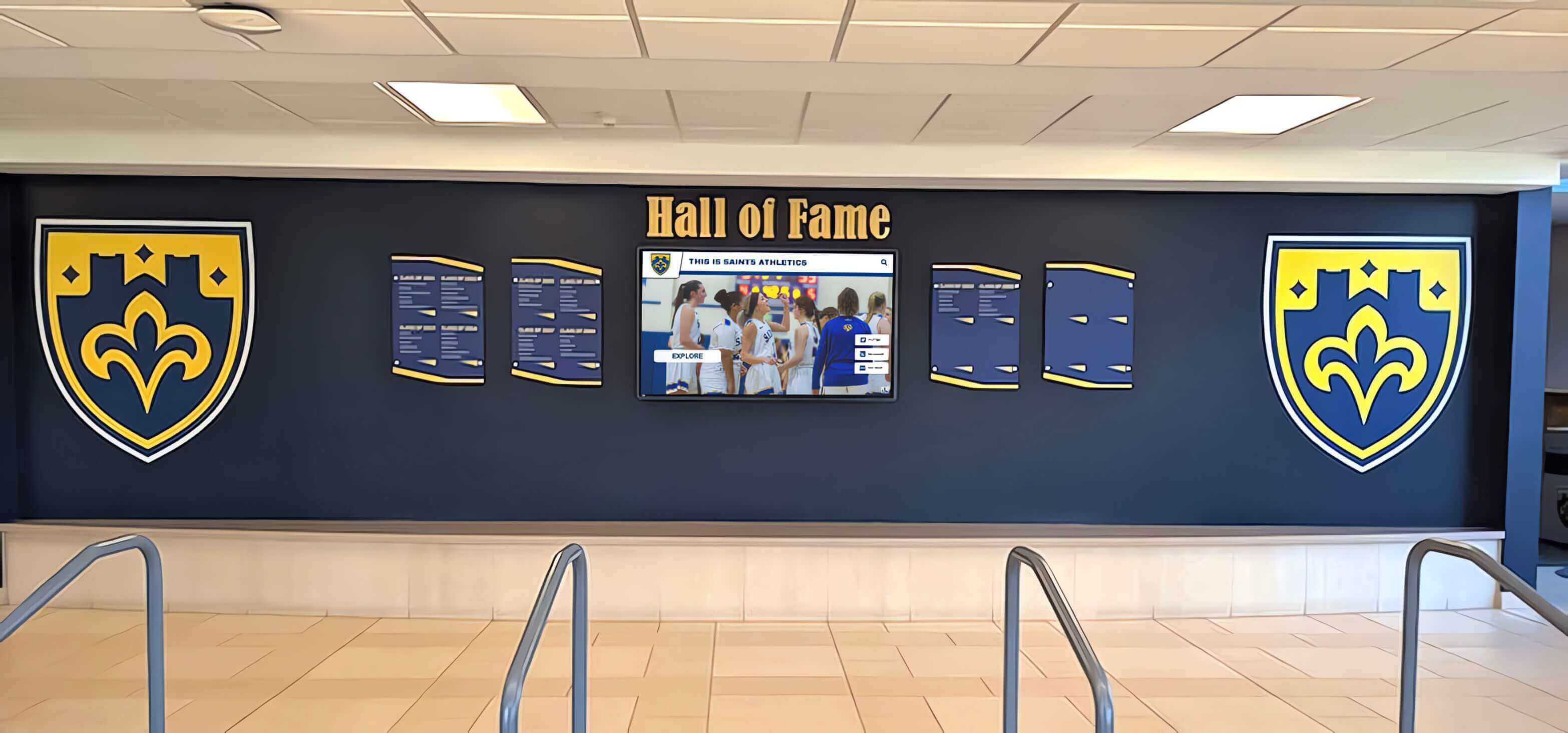
Schools increasingly combine traditional recognition elements—plaques, shields, trophy cases—with digital displays that extend the capacity and updateability of the recognition environment
Frequently Asked Questions About Swimming Record Boards
How many event categories should a high school swimming record board include?
A complete high school swimming record board typically includes 12–14 individual events per gender plus 3 relay events per gender, based on the standard NFHS competitive event menu. Schools running fewer events at the varsity level can reduce that count. Programs offering diving should include 1-meter and 3-meter diving records separately. The exact event list should match the school’s current competitive schedule—record categories for events the program no longer contests are still worth preserving as historical archive entries.
What documentation is required to officially recognize a new swimming record?
The minimum acceptable documentation is an official meet results sheet or timing system printout showing the swimmer’s name, event, heat, lane, and official time, authenticated by the meet referee. For relay records, the official heat sheet confirming all four swimmer names and the team time is required. Unofficial timing displays, coaching notes, or individual athlete records are not sufficient documentation for official record recognition.
How should relay records be handled when a team member transfers or graduates?
Once a relay record is officially documented and posted, the four swimmers’ names remain on the record permanently—even if they transfer, graduate, or are otherwise no longer with the program. The record belongs to the team that swam it. Future relay records replace the displayed record but don’t retroactively alter who swam the previous best time. Digital systems handle this naturally; physical boards often omit prior relay holders entirely when repainting.
Can a swimming record board include long course (meter) records alongside short course (yard) records?
Yes, but they must be displayed as separate categories with unambiguous labeling. Yards and meters are different courses—the 200-meter freestyle and the 200-yard freestyle are different events with different record standards. Combining them or failing to label them creates a display that actively misleads visitors. Most school programs track short course yard records exclusively; programs that contest both should maintain clearly separate record categories for each.
How often do school swimming record boards need to be updated?
This depends on the program’s competitive activity. A program with active record-breaking across multiple events may need updates after every dual meet during championship season. A more established program where records have stood for years may update only a few times per season. The update process should be fast enough that records don’t sit in a verification queue for weeks—digital platforms make same-week updates routine; painted boards make same-week updates structurally impossible.
Swimming records are among the most precise forms of athletic achievement documentation—times measured to hundredths of a second, relay teams built from four individuals’ best performances combined into one mark. The display format and verification workflow chosen to honor those records should match their precision. A swimming record board that is consistently accurate, fully archived, and updated as records actually fall tells a program’s story the way it deserves to be told.
Schools ready to replace outdated painted boards or static displays with a purpose-built digital record platform can explore how Rocket Alumni Solutions deploys interactive touchscreen systems specifically for athletic programs—combining swimming record boards, hall of fame displays, and team histories within unified, updateable displays. See how it works.