Intent: plan. A high school athletic department budget that accounts for recognition—awards, record boards, hall of fame displays, and digital screens—avoids the cycle of underfunded programs and outdated displays that undermine athlete morale and community engagement.
Every athletic director knows the tension: recognition programs are important, but line items for trophies, plaques, and display systems compete with uniforms, equipment, and travel. The result is often a patchwork approach—a painted record board that hasn’t been updated in three years, a trophy case that ran out of shelf space during a championship run, and an awards ceremony funded by whatever remains in March.
This guide provides a practical framework for budgeting athletic department recognition programs—covering awards, physical and digital record boards, hall of fame infrastructure, and touchscreen display systems—so athletic directors and administrators can plan effectively across budget cycles rather than reacting to recognition gaps after they appear.
Athletic department budgets are under pressure from every direction. According to the National Federation of State High School Associations, participation in high school athletics consistently involves millions of students annually, and the administrative infrastructure supporting those programs—including recognition—requires deliberate planning to function well. Recognition that feels like an afterthought tells athletes and community members exactly that.
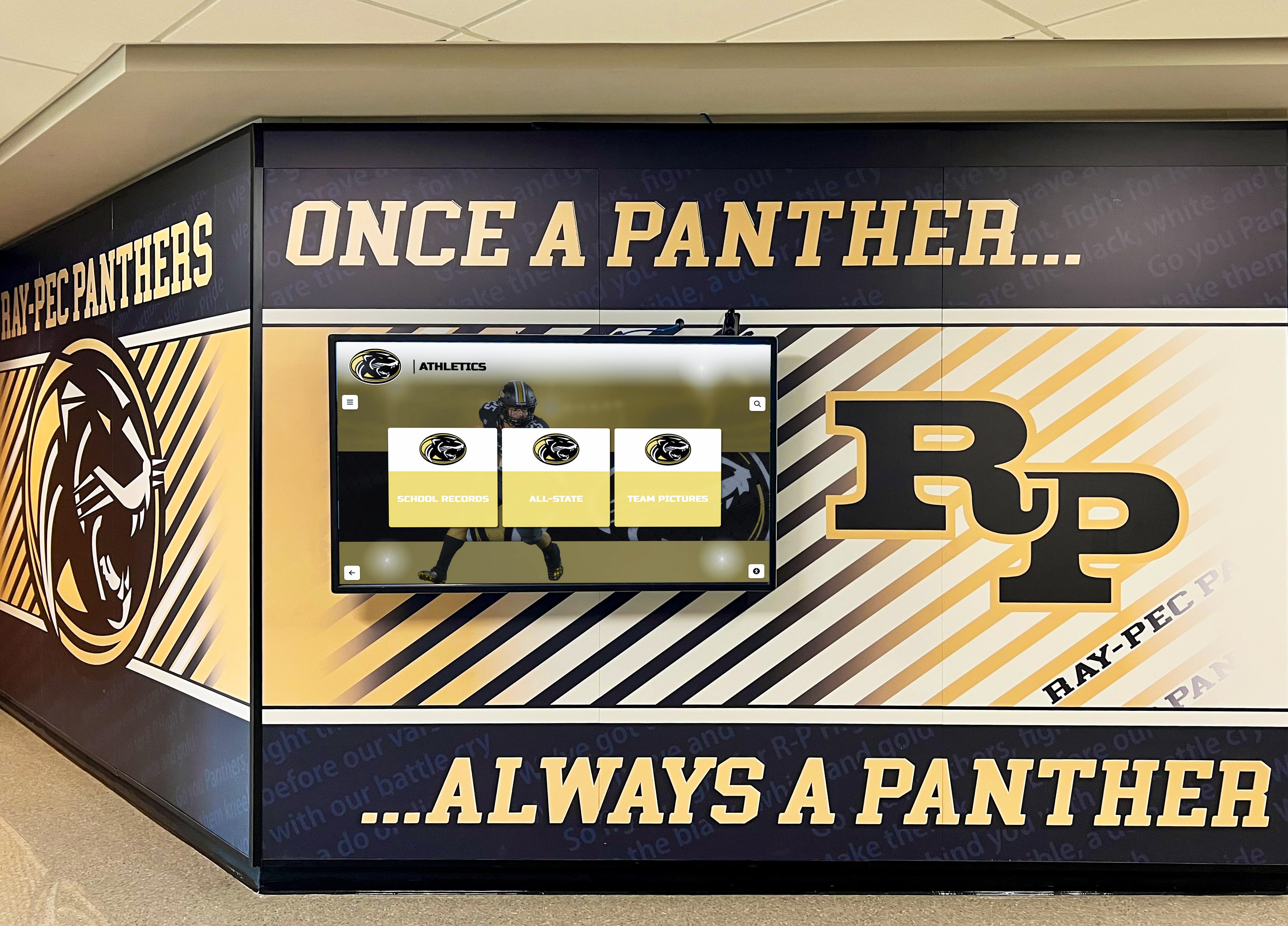
Athletic hallways that combine visual identity with digital displays signal program investment in recognition—and require budget planning to implement and maintain sustainably
Why Recognition Belongs in the Core Athletic Budget
Recognition programs are often treated as supplementary—funded when a surplus appears, deferred when the budget is tight. This approach creates cumulative problems that cost more to address than consistent investment would have.
Outdated record boards cost money to repaint when records are eventually corrected. Trophy cases filled beyond capacity require either expensive expansion or disposal of historical items. Awards purchased reactively at season’s end without planning tend to be generic rather than meaningful. And programs that defer digital display investments find themselves facing larger capital replacement decisions years later, without the institutional knowledge of how those systems should integrate with the broader recognition program.
Building recognition into the core budget—with line items that reflect realistic costs and planned upgrade cycles—prevents these recurring problems. It also positions the athletic department to make deliberate decisions about format and technology rather than being forced into whatever fits the remaining balance.
The Recognition Budget Categories to Plan For
A comprehensive recognition budget addresses four distinct areas:
- Annual awards and ceremony costs — trophies, plaques, medals, rings, banquet logistics
- Physical display maintenance — repainting, refurbishment, replacement of static record boards and trophy cases
- Digital display systems — hardware, software licensing, installation, ongoing support
- Archive and documentation — digitizing historical records, photography, content management
Each category has different cost drivers, update cycles, and long-term trajectories. Planning them together avoids the common mistake of optimizing one area while neglecting another.
Budgeting for Annual Athletic Awards
End-of-season awards represent the most visible and emotionally significant part of athletic recognition—and they happen on a predictable annual cycle, which makes them the most straightforward category to budget.
Per-Athlete Award Cost Ranges
Award costs vary significantly by type and quality tier. General planning ranges:
| Award Type | Typical Cost Range | Notes |
|---|---|---|
| Participation medals | $3–$12 each | Most affordable; appropriate for broad recognition |
| Standard trophies | $15–$60 each | Size and material drive cost |
| Custom engraved plaques | $25–$80 each | Personalization adds value; lead time matters |
| Letterman jackets or varsity letters | $40–$200+ each | Often funded through separate booster contributions |
| Championship rings | $80–$400+ each | Reserved for championship seasons; significant per-unit cost |
| Personalized senior gifts | $20–$100 each | Growing category; personalized recognition for senior athletes shows what’s possible |
For a mid-sized high school running 12–15 sports programs with 300–500 active athletes, annual award costs commonly range from $8,000 to $25,000 depending on the recognition tier each sport receives and whether championship seasons trigger additional investment.
Building the Awards Budget Line
Accurate awards budgeting requires:
- A sport-by-sport participant count from the previous season
- A defined award tier for each sport (participation, varsity letter, individual achievement, team champion)
- A per-unit cost from current vendor pricing, not estimates from prior years
- A contingency line for unexpected championship seasons or special recognition needs (typically 10–15% of the awards subtotal)
Athletic directors who request quotes in September rather than February lock in pricing before peak award-season demand and have time to explore vendor options without timeline pressure.
Academic and Character Awards
Recognition programs that extend beyond athletic performance—academic achievement, leadership, sportsmanship, community service—add line items to the awards budget but deliver outsized value in demonstrating that the athletic department’s values extend beyond wins and losses.
These awards are typically less expensive per unit than athletic achievement trophies, but they require the same planning discipline. Knowing in advance how many academic achievement awards, character awards, and leadership recognitions a program intends to present prevents the last-minute scramble that results in generic or absent recognition.
Interactive displays for student achievement recognition offer a framework for programs that want to honor academic and character achievement alongside athletic performance in the same display environment.
Ceremony and Banquet Costs
Award ceremonies and end-of-season banquets carry costs that belong in the recognition budget:
- Venue rental (if off-campus)
- Catering or meal service
- Audio-visual equipment
- Program printing
- Photographer or videographer
- Slideshow or highlight video production
Programs that host all-sports banquets rather than sport-by-sport events consolidate these costs but require more coordination. Sport-specific celebrations allow more tailored recognition but multiply venue and logistics expenses. Neither approach is inherently correct—the right choice depends on program culture and administrative capacity.
Budgeting for Athletic Record Boards
Record boards represent a different budget challenge: they’re not annual purchases, but they require periodic investment that programs often fail to anticipate. The result is record boards that fall behind reality—marking times, distances, and scores that haven’t been accurate for years.
Static Board Maintenance Costs
Traditional painted record boards carry ongoing costs that are easy to underestimate:
- Repainting: Professional repainting of a gymnasium wall record board typically costs $500–$2,500+ per session, depending on board size, scope of changes, and regional labor costs. Programs with active record-breaking across multiple sports may need repainting every one to two years.
- Supplemental plaques: Some programs use engraved plaques for records, adding fabrication costs of $25–$150 per record update, plus installation.
- Deferred updates: Records not updated due to budget constraints create inaccuracy that erodes program credibility with athletes and alumni who notice discrepancies.
A realistic static board maintenance budget for a program tracking records across 10–15 sports is $1,000–$4,000 per year, accounting for regular repainting and the occasional comprehensive refresh.
Digital Record Board Costs
Digital and touchscreen record boards carry a different cost structure: higher upfront investment, lower recurring costs, and significantly greater functionality.
A purpose-built digital record board system involves:
- Hardware: Commercial-grade display (55"–86" depending on space) typically $800–$3,500, plus mounting hardware and computing components
- Software licensing: Varies by vendor—one-time licensing models run $3,000–$8,000; annual subscription models run $800–$2,500/year
- Installation: $500–$2,000 depending on facility and network infrastructure
- Ongoing support: Included in many packages; standalone annual support plans typically $300–$800/year
The digital record board guide covering mentorship and alumni discovery illustrates how these systems extend beyond simple record display into connected recognition experiences—which affects how to frame the investment in budget presentations.
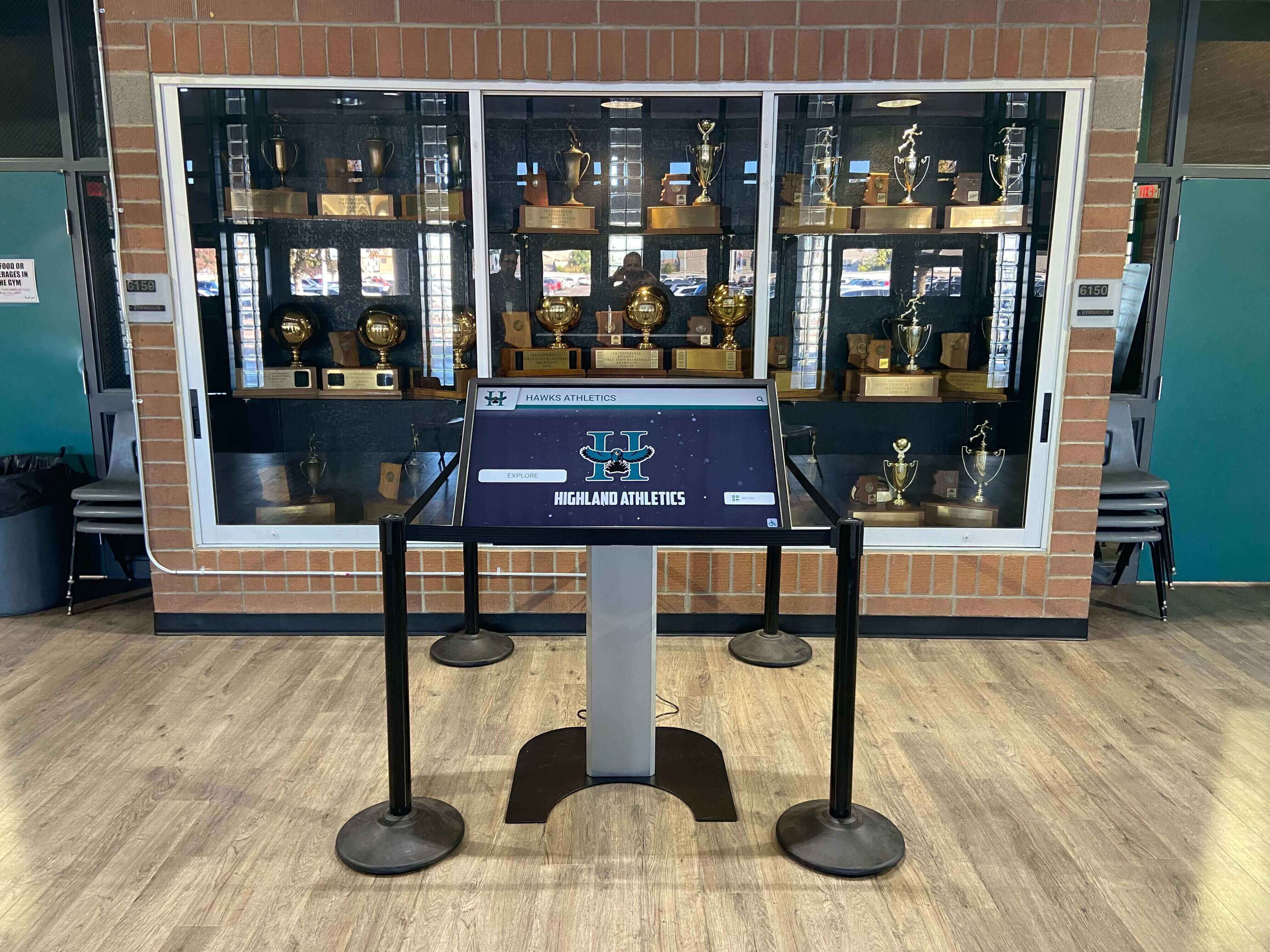
Digital displays installed in trophy case areas serve multiple recognition functions simultaneously, consolidating hardware costs across programs
Five-Year Cost Comparison: Static vs. Digital Record Boards
| Cost Category | Static Board (5 Years) | Digital System (5 Years) |
|---|---|---|
| Initial investment | $1,000–$3,000 (initial painting) | $5,000–$12,000 (hardware + software) |
| Annual maintenance | $1,000–$4,000/year | $300–$800/year |
| 5-year total | $6,000–$23,000 | $6,500–$16,000 |
| Update speed | Weeks to months | Same day |
| Content capacity | Fixed wall space | Unlimited |
| Community accessibility | In-person only | In-person + mobile via QR |
Programs that break records regularly—strong cross-country, track, swimming, or throwing programs—often find digital systems reach cost parity within three to four years when painting costs are calculated honestly.
Budgeting for Hall of Fame Programs
Athletic halls of fame carry the most significant budget complexity because they involve decisions about physical infrastructure, nomination and selection processes, annual induction ceremonies, and long-term display maintenance—all of which persist indefinitely once the program is established.
Start-Up Costs for New Hall of Fame Programs
Programs establishing a hall of fame for the first time face a set of one-time costs that should be separated from ongoing annual expenses in budget planning:
- Display infrastructure: Physical plaques, display cases, or digital systems housing inductee profiles — $2,000–$15,000+ depending on scope and format
- Historical research and archive creation: Compiling records, photographs, and biographical information for initial inductees — often underestimated; 20–50 hours of staff or volunteer time per initial class
- Nomination and selection process design: Criteria documentation, selection committee logistics, legal review of nomination forms
- Inaugural ceremony: Often a larger event than subsequent inductions, with costs for venue, catering, media coverage, and alumni outreach
These start-up costs are often absorbed through a combination of booster club contributions, alumni donations, and capital budget allocations rather than operating budget alone. Booster club fundraising strategies offer a practical starting point for programs that need to supplement operating budget funding for initial infrastructure investment.
Annual Hall of Fame Operating Costs
After establishment, hall of fame programs carry predictable annual costs:
- Induction ceremony (venue, catering, awards, program printing): $2,000–$8,000
- New inductee display addition (plaque fabrication or digital profile update): $50–$500 per inductee depending on format
- Alumni outreach and communication: Staff time plus any print or digital communication costs
- Photography for new inductees: $200–$600 per ceremony
Programs that digitize their hall of fame content gain significant ongoing cost advantages. Adding a new digital inductee profile costs a fraction of fabricating and installing a physical plaque, and the content can include photographs, career statistics, and biographical narrative that physical plaques cannot accommodate at any price.
Physical vs. Digital Hall of Fame Display Costs
Traditional hall of fame displays—plaques, portrait frames, trophy cases—look authoritative but carry compounding maintenance costs as programs age and wall space fills:
- Plaque fabrication per inductee: $100–$500
- Portrait framing and installation: $50–$200 per inductee
- Wall space eventually exhausted: requires facility modification or program redesign
Digital hall of fame platforms change this calculus. The display infrastructure scales without physical expansion, inductee content can be updated or enriched over time, and community access extends via mobile devices.
Donor Recognition Integration
Programs that integrate athletic donor recognition with hall of fame displays—acknowledging major facility funders, scholarship donors, and long-term booster contributors alongside athletic inductees—often find a funding partner in the development office willing to share display infrastructure costs.
What schools should share in donor impact reports provides context for how donor recognition content should be structured to satisfy donors and institutional reporting requirements simultaneously. When advancement and athletic departments share display infrastructure costs, both programs benefit from higher-quality systems than either could justify independently.
Planning for Digital Display Systems
Touchscreen and digital display systems represent the highest-complexity budget decision in athletic recognition because they involve capital investment, technology relationships, and operational changes that persist for years after purchase.
Understanding the Total Cost of Digital Display Ownership
Budgeting only for hardware is the most common planning error with digital display systems. A complete cost model includes:
One-time costs:
- Display hardware (commercial-grade screens rated for 16+ hours daily operation)
- Mounting hardware and installation
- Network infrastructure upgrades (if required)
- Initial content creation and data entry (often 20–40 hours for comprehensive setup)
- Staff training
Ongoing costs:
- Software licensing (one-time or annual subscription depending on vendor model)
- Annual support or maintenance contract
- Content management staff time (typically 2–5 hours per month for routine updates)
- Hardware warranty and eventual replacement (commercial displays typically rated for 5–7 years)
Advancement and marketing teams using digital recognition platforms operate with similar total cost frameworks—the experience from advancement office digital displays translates directly to athletic department budget planning.
Hardware Size and Cost by Application
| Application | Recommended Size | Typical Hardware Cost |
|---|---|---|
| Lobby/main entrance display | 75"–86" | $1,500–$4,000 |
| Trophy case integration | 55"–65" | $800–$2,500 |
| Hallway display | 55"–75" | $900–$3,000 |
| Gymnasium lobby kiosk | 65"–75" | $1,200–$3,500 |
Commercial-grade displays rated for institutional use cost significantly more than consumer televisions but operate reliably under conditions—continuous daily operation, temperature variation, high-traffic environments—that consumer hardware isn’t designed to handle. Planning consumer-grade hardware into a permanent athletic facility installation typically results in premature failure and unplanned replacement costs.
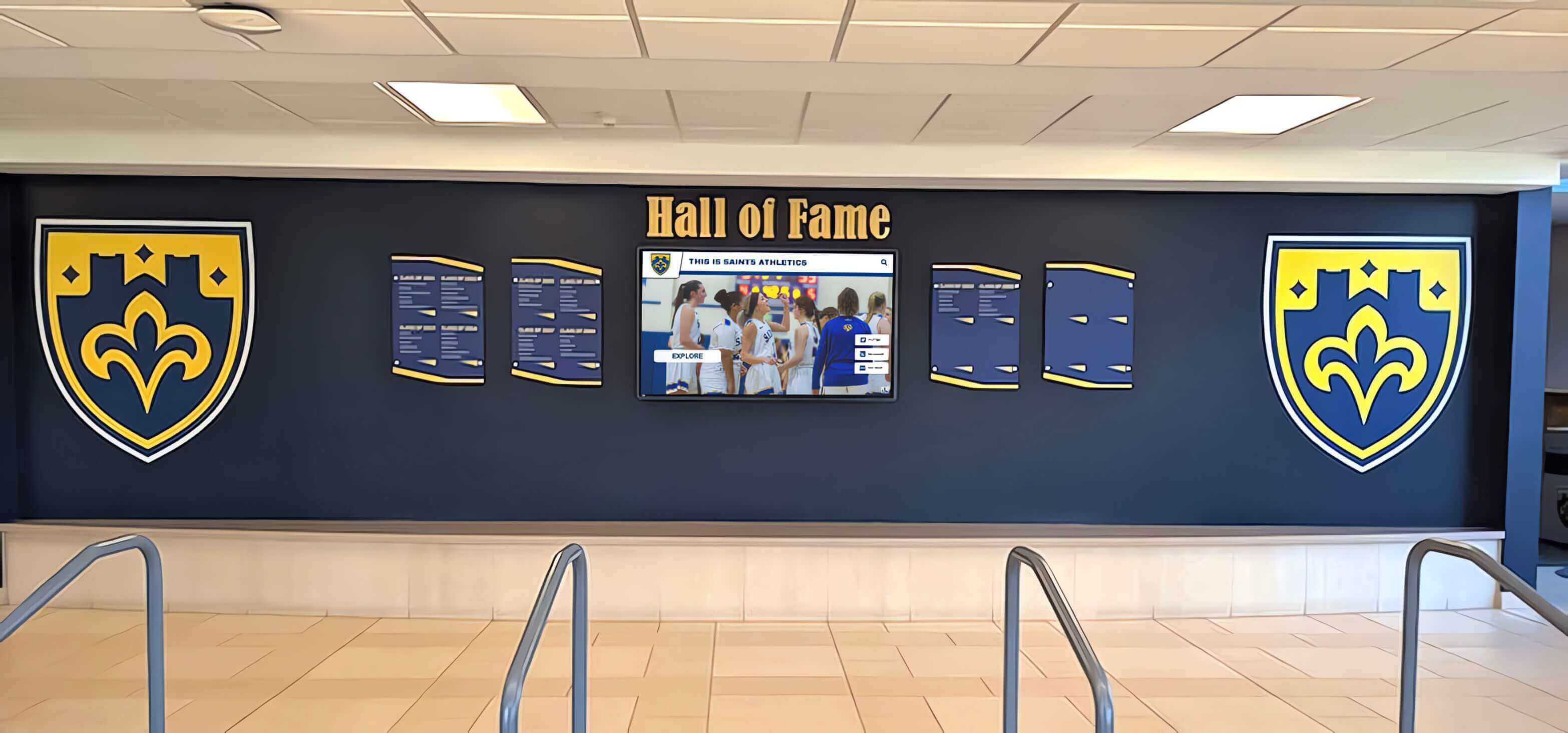
Hybrid installations combining physical recognition elements with digital displays allow programs to integrate legacy infrastructure with interactive content management
Software Pricing Models: One-Time vs. Subscription
Software pricing structure matters as much as the annual dollar amount when planning multi-year budgets.
One-time licensing fits capital budget categories in districts with rigid operating/capital distinctions. The upfront cost is higher but eliminates recurring software expense. For programs planning to operate the same system for seven or more years, one-time licensing is typically less expensive in total.
Subscription pricing fits operating budget categories and is easier to fund annually without a capital approval process. It also reduces initial outlay, making the investment more accessible for programs with limited capital reserves. Over time, however, subscription costs typically exceed equivalent one-time licensing fees—and prices usually increase annually.
Understanding your district’s budget classification rules before selecting a pricing model prevents discovering that the preferred option can’t be purchased through the available budget mechanism. Athletic directors who engage their business office early in the evaluation process avoid this problem.
Building the Business Case for Digital Investment
Presenting a digital display investment to administration requires framing the investment in terms administration understands:
- Total cost of ownership compared to continuing with static alternatives (see record board cost table above)
- Recognition program gaps the current system creates (outdated records, capacity-constrained trophy cases, awards with no lasting display)
- Community and alumni engagement benefits from broader content accessibility
- Long-term scalability without recurring physical expansion costs
Sports display case ideas that extend recognition impact illustrate how digital formats expand what recognition programs can communicate beyond the physical constraints of traditional display cases—useful context for administration presentations.
A Step-by-Step Budget Planning Process
Athletic directors who build recognition budgets systematically—rather than reactively—avoid the most common budget problems.
Step 1: Inventory Current Recognition Assets
Before planning future spending, document what currently exists:
- Physical record boards: condition, last update date, accuracy assessment
- Trophy cases: current capacity, overflow situation, condition of existing items
- Hall of fame display: current capacity, update frequency, condition
- Digital displays: any existing systems, age, software version, support status
This inventory reveals which categories require immediate investment versus scheduled maintenance, and establishes a baseline for measuring improvement.
Step 2: Calculate True Ongoing Costs for Static Systems
For each static display in the inventory, estimate realistic annual maintenance costs including:
- Repainting or refabrication frequency and cost
- Physical space constraints and what happens when capacity is reached
- Staff time required for each update cycle
Many programs discover through this exercise that static systems cost more to maintain than they assumed—because maintenance costs are distributed across multiple budget categories and never appear as a single line item.
Step 3: Define Recognition Program Goals for the Next Three to Five Years
Recognition goals that affect budget planning include:
- Which new sports or categories should receive formal record tracking?
- Is a hall of fame program planned, and when should it launch?
- Should alumni and donor recognition be integrated with athletic recognition?
- What digital display capabilities does the program need within three years?
Goals defined at this stage prevent purchasing decisions that are immediately inadequate—for example, installing a system too small to accommodate a hall of fame program being planned for the following year.
Step 4: Build a Three-Year Recognition Budget Model
A three-year view allows programs to plan capital investments alongside operating costs without annual budget surprises:
Year 1: Annual awards + record board assessment + hall of fame research + digital display evaluation Year 2: Annual awards + record board system decision + hall of fame launch (if planned) + digital display procurement (if approved) Year 3: Annual awards + first full year of digital system operation + hall of fame first induction class + content management workflow established
This timeline is illustrative—programs with existing infrastructure or approved capital budgets may compress it. The principle is that recognition investments are most effective when planned in sequence rather than decided independently.
Step 5: Identify Funding Sources Beyond the Operating Budget
Recognition programs frequently benefit from funding sources that supplement operating budget allocations:
- Booster club contributions: Many booster organizations have specific recognition program mandates
- Alumni donations: Named award funds, hall of fame induction sponsorships, display dedication opportunities
- Title IX compliance review: Programs ensuring equitable recognition across men’s and women’s sports may qualify for designated equity funding
- Community foundation grants: Some foundations support school recognition infrastructure, particularly for underserved programs
Alumni engagement tools that connect recognition to giving programs demonstrate how digital recognition platforms can simultaneously serve alumni engagement and fundraising functions—a useful frame for securing development office partnership in recognition infrastructure investment.

Digital recognition displays create community touchpoints that support alumni engagement and donor cultivation alongside their core recognition function
Common Budget Planning Mistakes to Avoid
Budgeting for Hardware Only
The most frequent planning error: calculating display hardware costs and treating that as the total investment. Software, installation, content creation, and ongoing support add 30–80% to hardware cost in a properly planned implementation.
Treating Recognition as a Single Budget Line
A single “recognition” line item obscures the different cost structures for awards, static displays, digital systems, and ceremonies. Separating these into distinct line items makes maintenance needs visible and prevents one category from cannibalizing another when budget pressure appears.
Ignoring Update Costs in Year One Pricing
Vendors selling static display systems rarely emphasize ongoing update costs—they appear at repainting time, not at purchase. Digital system vendors sometimes similarly underemphasize content management requirements. Build update costs explicitly into multi-year models before comparing options.
Deferring Digital Decisions Indefinitely
Programs that defer digital display decisions often find themselves making larger, more expensive decisions later—after static systems have failed, after trophy cases have overflowed, or after community expectations for interactive recognition have risen. Early investment in digital infrastructure typically costs less in aggregate than delayed replacement of failed static systems.
Frequently Asked Questions: Athletic Department Budget Planning
How much should a high school athletic department budget for recognition annually?
There’s no universal standard, but programs that treat recognition as a core program expense rather than a discretionary supplement typically allocate 3–8% of total athletic operating budget to awards, displays, and ceremony costs. Programs with growing hall of fame programs or planned digital display investments operate at higher percentages during capital investment years.
Can digital display systems be funded through capital budgets rather than operating budgets?
Yes, and in many districts this is the appropriate funding mechanism. Hardware purchases fit standard capital expenditure criteria. Software may be categorized differently depending on whether the vendor offers one-time licensing (often capitalizable) or subscription pricing (typically operating). Engaging the business office before vendor selection prevents budget classification surprises.
How do programs justify digital display investment when budgets are tight?
The strongest justifications combine total cost of ownership modeling (showing that digital systems often cost less over five years than equivalent static system maintenance) with non-financial benefits: recognition program accuracy, community engagement, alumni connection, and scalability without physical expansion. Programs that have successfully made this case often frame digital displays as infrastructure, not decoration.
What’s the right timeline for planning a hall of fame program launch?
Most programs benefit from 12–18 months of planning before an inaugural induction ceremony: three to six months for criteria development and nomination process design, three to six months for historical research and initial class identification, and six months for ceremony planning and display installation. Programs that compress this timeline typically discover they underestimated the historical research workload.
How do booster clubs typically contribute to recognition program funding?
Common models include booster funding for annual awards (particularly for sports with strong parent booster organizations), capital contributions to display systems (often associated with naming opportunities), and event sponsorship for banquets and ceremonies. Formalizing the relationship between booster contributions and recognition program funding in written agreements prevents expectation mismatches when leadership changes on either side.
Should athletic and academic recognition displays share infrastructure?
When facilities allow, shared display infrastructure reduces per-program costs and creates a more unified recognition environment for the school community. Many digital platform vendors support multiple recognition categories—athletic records, academic honors, leadership, donor recognition—within a single system. Programs considering shared infrastructure should involve both athletic and academic administrators in the platform selection process.
Building a high school athletic department budget that accounts for recognition is not a one-time exercise—it’s an ongoing planning practice that rewards programs that approach it systematically. Awards that feel meaningful, record boards that stay accurate, hall of fame displays that keep growing, and digital systems that engage the community year-round all require planning that starts well before budget season.
Programs looking to modernize their recognition infrastructure—integrating record boards, hall of fame content, award archives, and alumni engagement into a unified digital system—can explore Rocket Alumni Solutions to see how purpose-built touchscreen platforms serve high school athletic departments navigating exactly these budget and planning decisions.