Schools across the country maintain halls of fame recognizing exceptional athletes, scholars, coaches, and contributors who shaped institutional history. These recognition programs celebrate excellence, preserve tradition, and inspire current students to pursue their own achievements. Yet behind every hall of fame inductee stands a careful selection process determining who receives this honor.
The path from nomination to induction involves multiple stakeholders reviewing candidates against established criteria. Selection committees evaluate athletic records, academic achievements, character standards, and lasting contributions. Schools balance recognizing historic figures with recent graduates, individual excellence with team championships, and maintaining high standards while expanding recognition opportunities. Meanwhile, how these inductees are displayed continues to transform as digital touchscreen systems replace traditional plaques constrained by physical space.
This comprehensive guide examines how schools structure hall of fame selection processes and how modern digital displays showcase inductees through interactive touchscreen technology.
Understanding hall of fame selection criteria and display options helps schools create recognition programs that honor achievement fairly while engaging students, alumni, and visitors meaningfully. Schools establishing new programs or refining existing ones benefit from examining proven approaches balancing prestige with inclusivity.
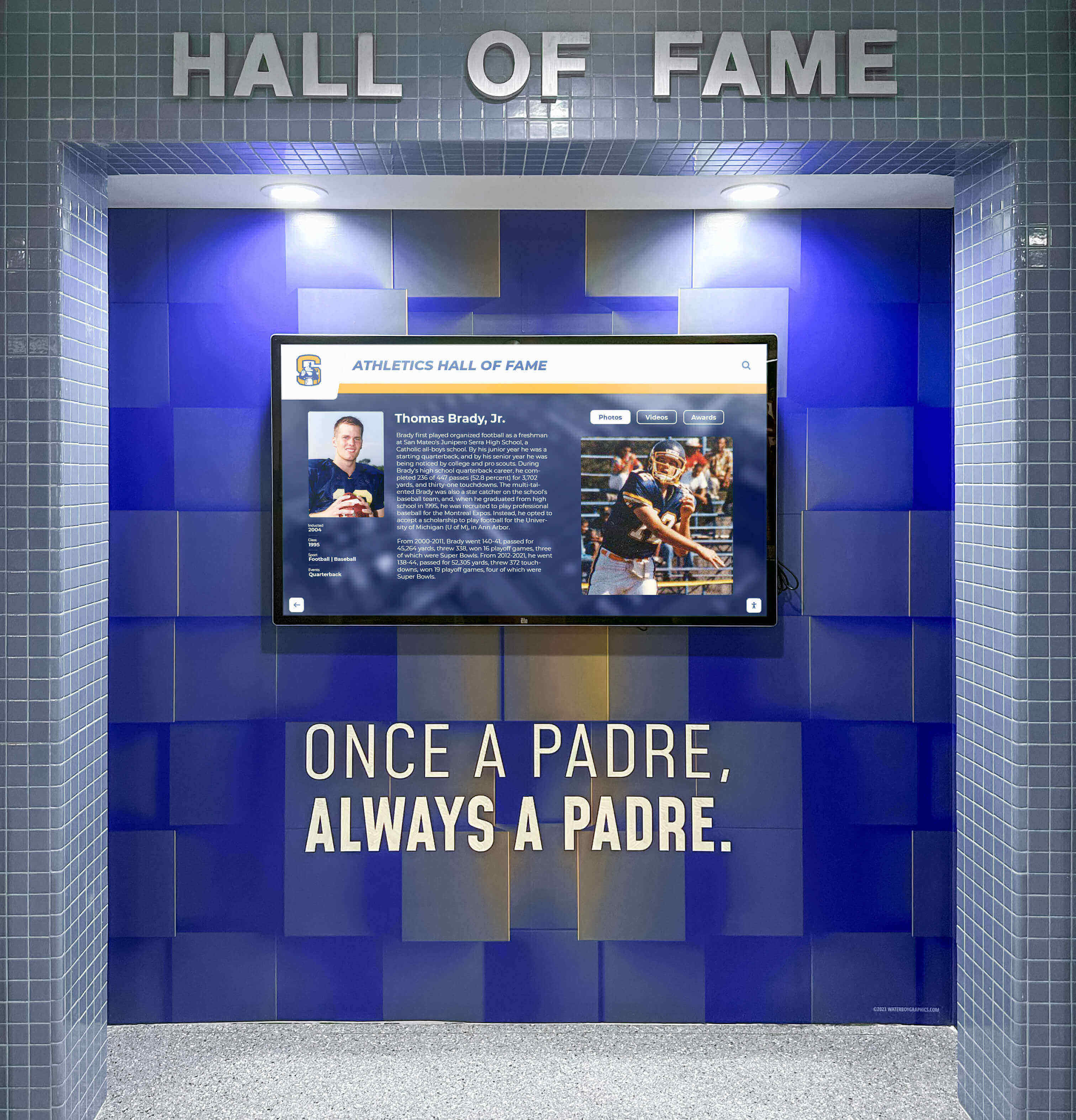
Digital hall of fame displays provide interactive access to unlimited inductee information
How Schools Structure Hall of Fame Selection Processes
Hall of fame selection processes establish transparent frameworks ensuring every candidate receives fair consideration based on objective criteria rather than popularity or connections.
Establishing Clear Selection Criteria
Most successful hall of fame programs begin with written criteria defining what achievements qualify candidates for induction.
Athletic Achievement Standards
Athletic halls of fame typically require candidates to meet multiple achievement benchmarks:
- All-state recognition in their sport during high school career
- Conference or league championship participation with significant contributions
- Record-holding performances in statistical categories
- Multi-sport participation with excellence across multiple programs
- College athletic scholarships or professional sports careers
- State tournament or playoff advancement through individual excellence
- Career statistics ranking in top percentages of program history
These objective measures provide concrete evaluation standards reducing subjective judgment.
Academic Excellence Requirements
Academic halls of fame establish different achievement thresholds:
- Valedictorian or salutatorian status at graduation
- National Merit Scholar recognition or similar academic honors
- Perfect or near-perfect standardized test scores
- Acceptance to highly selective colleges and universities
- Significant scholarship awards based on academic merit
- Published research or competition victories in academic fields
- Class rank in top percentile with challenging course loads
Academic recognition programs often complement hall of fame selections with annual student achievement awards.
Character and Citizenship Standards
Achievement alone rarely guarantees induction. Most programs include character requirements:
- Demonstrated sportsmanship throughout athletic career
- Positive contributions to school community and culture
- Absence of major disciplinary issues or eligibility violations
- Role model behavior worthy of ongoing celebration
- Post-graduation contributions to community or profession
- Values alignment with institutional mission and standards
These standards ensure inductees represent qualities schools want students emulating.
Waiting Period Requirements
Most programs establish time gaps between graduation and eligibility ensuring achievements remain significant when viewed in broader context.
Common Waiting Period Standards
- Ten years after graduation represents the most common athletic standard
- Five years frequently applies for coaches and special contributors
- Academic halls of fame may require shorter periods
- Exceptions sometimes exist for deceased individuals
- Clear policies govern extraordinary circumstances
Waiting periods allow committee members to assess lasting impact rather than recent popularity.
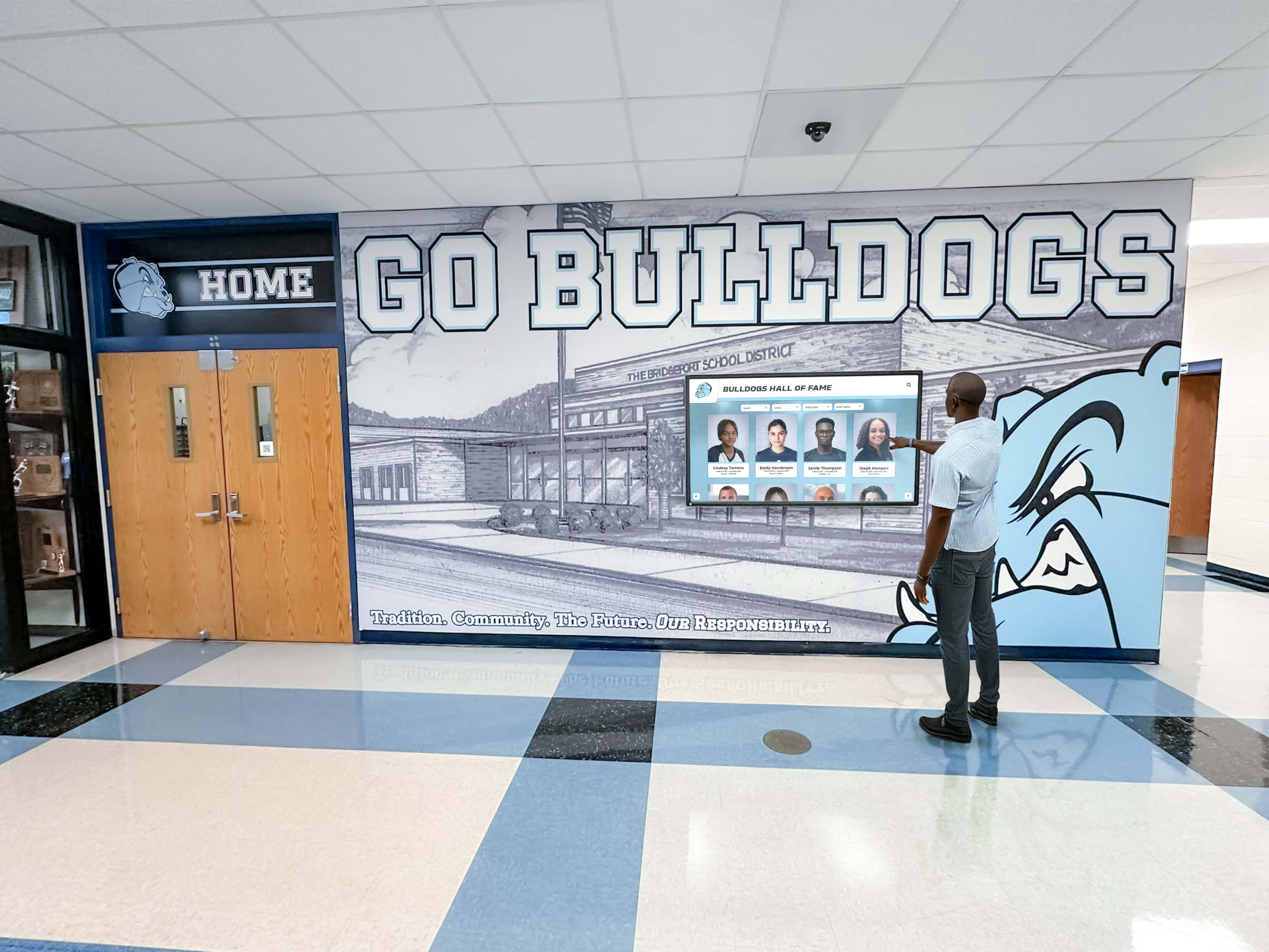
Committee members evaluate how recognition displays present inductee information
Post-Graduation Achievement Consideration
Some programs factor post-high school accomplishments into evaluation:
- Professional or Olympic athletic careers enhancing program prestige
- Distinguished careers in law, medicine, business, or public service
- Military service recognition and leadership positions
- Continued involvement supporting school programs
- Community leadership demonstrating values learned during school years
This balanced approach recognizes both high school achievement and lifetime impact.
Selection Committee Structure and Responsibilities
Effective committees combine institutional knowledge with diverse perspectives ensuring fair evaluation across sports, eras, and candidate categories.
Committee Composition Best Practices
According to guidance from the National Federation of State High School Associations, selection committees typically include five to nine members representing different stakeholder groups:
Core Committee Members
- Athletic director serving as chair and administrative liaison
- Current head coaches from multiple sports programs
- School administrator providing institutional perspective
- Booster club representative connecting to support community
- Alumni from different graduating decades bringing historical context
- Community members understanding broader institutional impact
Committee Size Considerations
- Five to seven members provides sufficient diversity without becoming unwieldy
- Odd numbers simplify majority voting when consensus proves difficult
- Rotating membership with staggered terms maintains fresh perspectives
- Three to five year terms balance continuity with renewal
- Clear succession planning prevents knowledge loss during transitions
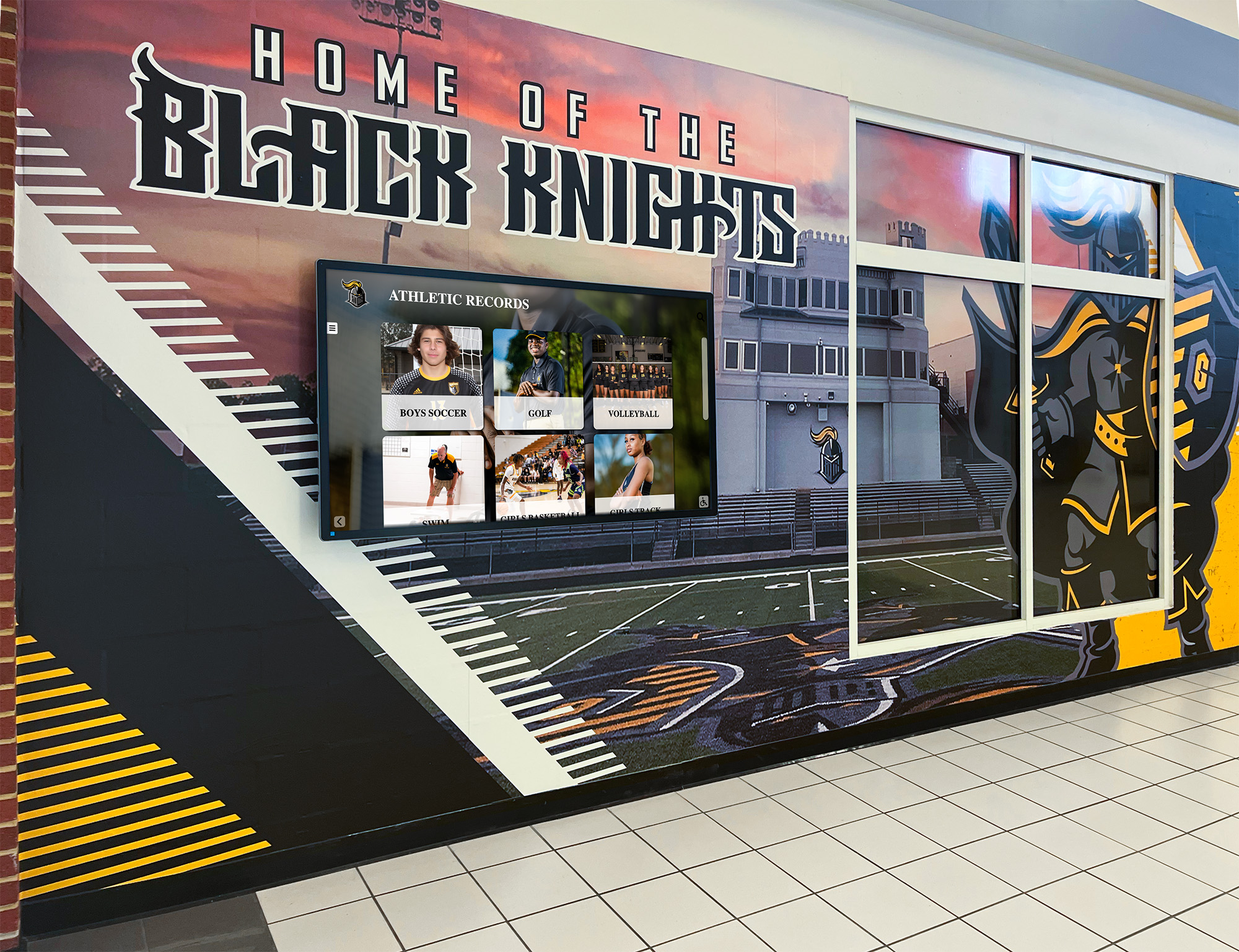
Committee planning shapes how recognition programs honor achievement across generations
Conflict of Interest Policies
Maintaining selection integrity requires clear conflict policies:
Recusal Requirements
- Committee members abstain when relatives are nominated
- Close personal or professional relationships trigger recusal
- Former coaches recuse for athletes they coached when recent
- Anonymous voting protects members from external pressure
- Documentation of recusals maintains transparency
Objectivity Standards
- Written evaluation forms standardizing candidate assessment
- Scoring systems quantifying achievement against criteria
- Multiple committee members researching each candidate independently
- Discussion protocols preventing dominant voices overwhelming others
- Documentation requirements supporting selection decisions
These safeguards maintain program credibility protecting against favoritism accusations.
Nomination and Selection Procedures
Clear procedures ensure consistent evaluation while encouraging broad participation from alumni and community members.
Public Nomination Process
Schools distribute nomination information through multiple channels:
- Nomination forms on athletic department and school websites
- Announcements at alumni gatherings and reunion events
- School newsletter and social media promotion
- Athletic event programs during championship games
- Community newspaper features and local media coverage
Making nominations accessible increases candidate pool quality ensuring worthy individuals receive consideration.
Required Nomination Information
Comprehensive nomination forms request:
- Nominee’s full name, graduation year, and current contact information
- Sports participated in with specific years and positions
- Statistical achievements, honors, and records set
- Team championships and individual recognitions earned
- Post-graduation athletic or academic career highlights
- Character evidence and citizenship contributions
- Supporting documentation including news clippings and photos
- Nominator information and relationship to candidate
Thorough information enables committees to evaluate candidates fairly against established criteria.
Athletic hall of fame programs balance individual recognition with team championship acknowledgment.
Selection Committee Review Process
Annual committee meetings follow structured procedures:
- Initial Review: Members receive all nominations weeks before meetings
- Research Phase: Committee verifies achievements against historical records
- Discussion Period: Members evaluate each candidate against criteria
- Deliberation: Group discusses relative merits of nominees
- Voting Process: Anonymous ballots determine inductee selections
- Class Size Determination: Maximum annual inductees prevents over-dilution
- Documentation: Written records explain selection rationale
Communication of Decisions
- Personal notification of inductees before public announcement
- Public celebration through press releases and social media
- Recognition of all nominees for consideration honor
- Clarity about resubmission process for future consideration
- Transparency about general process without compromising deliberations
Recognition Categories for Comprehensive Programs
Most established programs include multiple inductee categories acknowledging different types of excellence and contribution.
Individual Athletes and Scholars
Individual recognition honors personal achievement meeting established standards:
- Former student-athletes with exceptional high school careers
- Academic scholars with outstanding intellectual achievements
- Multi-sport athletes demonstrating excellence across programs
- Record holders in specific statistical categories
- Championship team members with standout individual performances
Championship Teams
Team recognition preserves collective achievement:
- State championship teams in any sport
- Undefeated or exceptional-record teams
- Conference championship teams with dominant performances
- Teams breaking significant program records
- Historic teams shaping program direction
End-of-year awards programs complement hall of fame recognition by celebrating current student achievements annually.
Coaches and Administrators
Leadership recognition acknowledges those building programs:
- Head coaches with significant tenure and championship success
- Assistant coaches with lasting program impact
- Athletic directors developing programs substantially
- Administrators creating conditions enabling athletic excellence
- Trainers and support staff with career-long contributions
Special Contributors and Supporters
Recognition extends beyond athletes and coaches to supporters:
- Booster club members providing exceptional financial support
- Community members advancing programs through volunteer service
- Officials maintaining program quality through decades
- Alumni sustaining connections and providing mentorship
- Donors enabling facility improvements and program expansion
This multi-category approach ensures comprehensive recognition across all program dimensions honoring everyone contributing to institutional excellence.
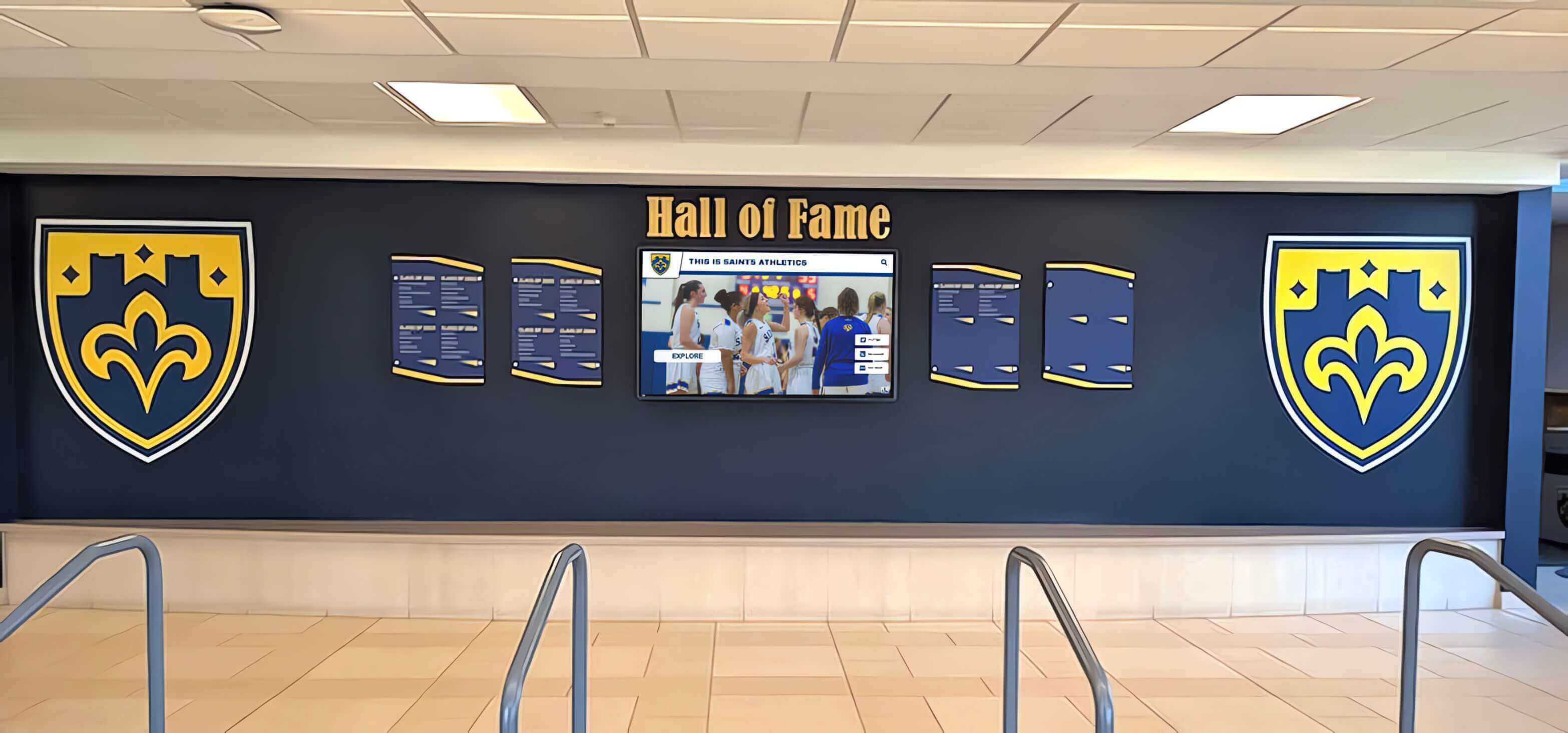
Comprehensive programs recognize athletes, teams, coaches, and contributors
How Digital Displays Showcase Hall of Fame Inductees
Traditional plaques face inevitable space constraints limiting how many inductees receive ongoing visibility. Digital touchscreen displays transform hall of fame presentation through unlimited capacity and interactive exploration.
Overcoming Traditional Display Limitations
Physical recognition faces significant constraints:
Space Exhaustion
- Trophy cases and wall plaques eventually fill available space
- Adding new inductees requires removing existing recognition
- Successful programs accumulate honorees faster than space expands
- Championship team rosters consume substantial display area
- Historical inductees often get removed accommodating recent classes
Update Challenges
- Engraved plaques require professional production with weeks of lead time
- Corrections to engraved recognition prove expensive or impossible
- Physical plaques accumulate dust requiring regular maintenance
- Student traffic causes damage necessitating replacement
- Adding post-induction achievements or updated photos remains impractical
Limited Information and Engagement
- Static plaques provide only basic name, year, and achievement
- No ability to share stories, statistics, or context
- Visitors cannot search for specific individuals or teams
- No connection between teammates or related inductees
- Statistical achievements lack comparative context
Digital Hall of Fame Display Advantages
Digital hall of fame displays eliminate these limitations through touchscreen technology and cloud-based content management.
Unlimited Recognition Capacity
- Single 55" to 86" touchscreen accommodates unlimited inductees
- Complete team rosters with individual profiles for every member
- Comprehensive achievement descriptions without word count limits
- Full photo galleries showing athletes in competition
- Video highlights impossible with traditional displays
- Historical archives preserving every inductee permanently
Interactive Exploration Features
Visitors engage with inductee information through intuitive interfaces:
- Search functionality finding specific athletes, teams, sports, or years
- Filtering by sport, decade, achievement type, or other criteria
- Individual profile pages with photos, statistics, and narratives
- Team pages linking all roster members with championship context
- Related content connecting teammates and multi-sport athletes
- Timeline views showing program evolution across decades
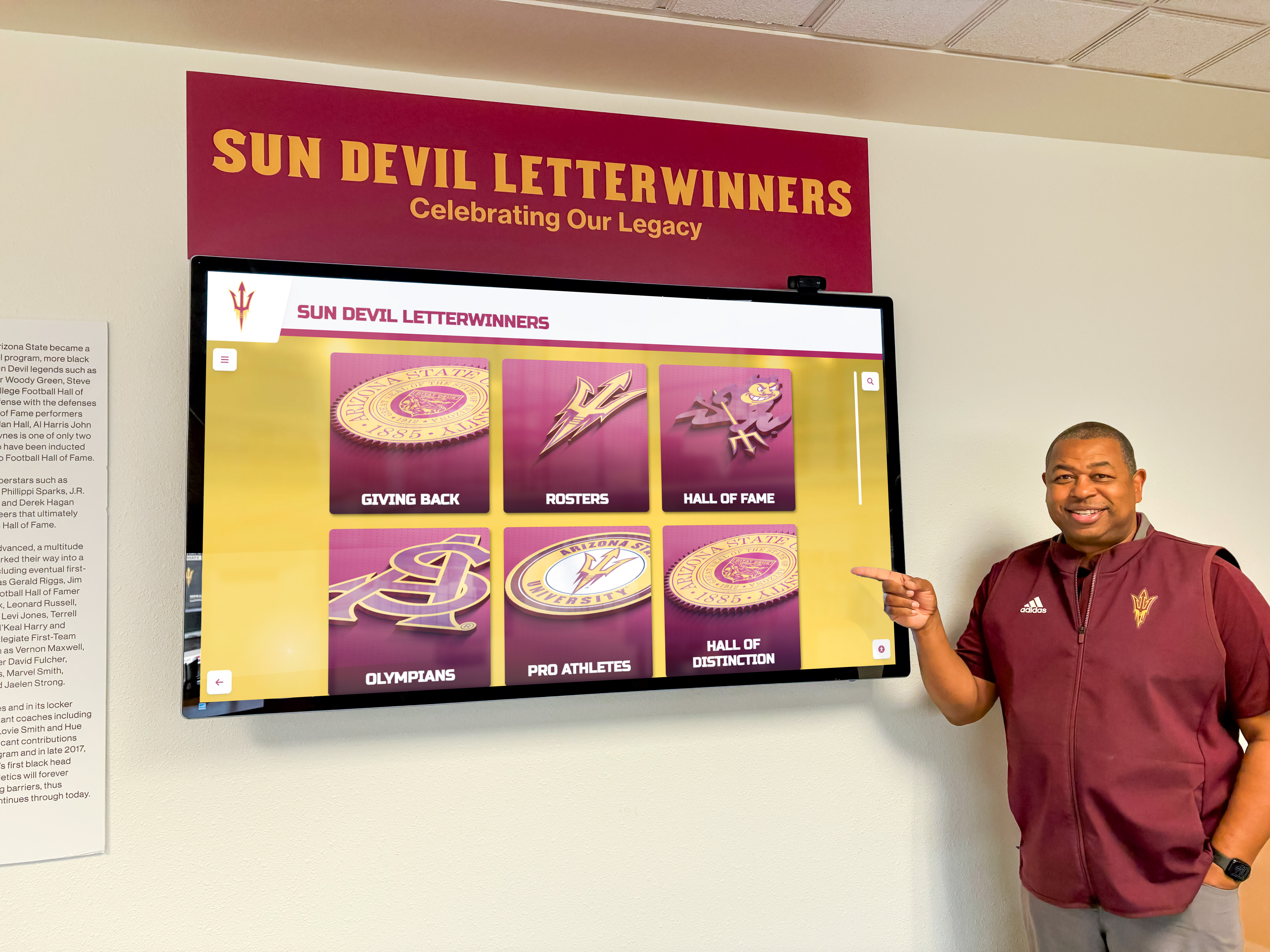
Touchscreen interfaces enable intuitive exploration of decades of inductee information
Simple Remote Content Management
Cloud-based platforms enable easy updates:
- Add new inductees immediately after ceremony
- Update information from any internet-connected device
- Correct errors or add details without hardware changes
- Upload photos and video through drag-and-drop interfaces
- Schedule content displays for specific dates or events
- Bulk import historical data during initial implementation
- Role-based permissions providing appropriate staff access
Schools report substantial time savings maintaining digital systems compared to coordinating plaque orders and installation.
Multi-Device Accessibility
Modern systems extend beyond physical displays:
- Web-accessible content enabling worldwide alumni viewing
- Mobile-responsive design working on phones and tablets
- Social sharing capabilities letting inductees share recognition
- QR codes providing mobile access to physical display content
- Integration with school websites and athletic department pages
- Email notifications announcing new inductee additions
This accessibility increases engagement far beyond visitors viewing physical displays.
Implementation Planning for Digital Displays
Successful digital hall of fame installations require several planning considerations:
Hardware Selection
- Commercial-grade displays rated for extended daily operation
- Screen sizes between 55" and 86" depending on viewing distance
- Touchscreen capability enabling interactive exploration
- Mounting solutions matching available wall or floor space
- Protective enclosures for high-traffic areas preventing damage
Software Platform Requirements
- Cloud-based content management accessible from multiple locations
- User-friendly admin interfaces non-technical staff can manage
- Unlimited inductee capacity without storage constraints
- Search, filter, and exploration features for visitors
- Media support including photos, videos, and documents
- Web and mobile accessibility extending reach
- Vendor support and training ensuring successful adoption
Strategic Placement
- High-traffic locations maximizing visibility and engagement
- Main entrance lobbies welcoming visitors and students
- Athletic hallways near locker rooms inspiring current athletes
- Alumni gathering areas during reunion events
- Adequate space for groups to gather and explore together
- Lighting conditions minimizing screen glare
- Viewing height accessible to all visitors
Touchscreen display installation timing considerations help schools coordinate recognition system deployment with construction projects.
Content Organization for Digital Hall of Fame Systems
How inductee information gets organized significantly impacts visitor engagement and exploration effectiveness.
Individual Inductee Profiles
Comprehensive individual profiles include:
Core Biography Information
- Full name with maiden names when applicable
- Graduation year and class information
- Sports participated in with years and positions
- High school athletic or academic achievements
- Post-graduation career highlights when relevant
- Induction year and class
Achievement Details
- Statistical records set during high school career
- Championship participation and individual contributions
- All-conference, all-state, or national recognition
- Awards and honors earned during school years
- Comparative statistics showing historical context
- Team records and milestones achieved
Visual Content
- Action photos showing athlete competing
- Senior portrait or graduation photo
- Team photos with championship context
- Current photos submitted by inductees
- Video highlights when available
- News clippings and historical documentation
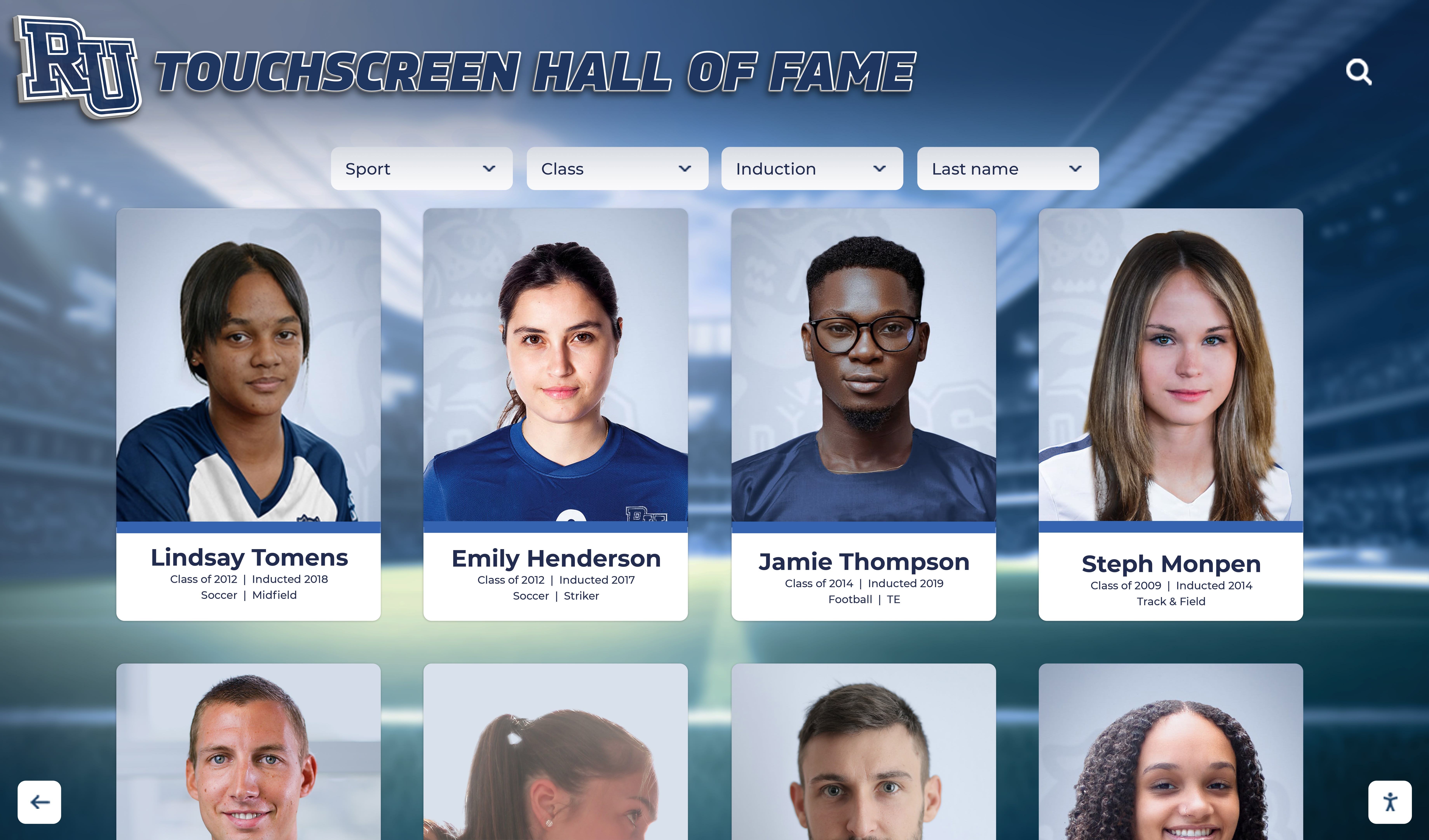
Individual profiles provide comprehensive information about each inductee's achievements
Team Recognition Pages
Championship team pages connect individual members:
- Team photo with full roster identification
- Season record and championship details
- Individual profiles for each team member
- Coaching staff recognition and profiles
- Game-by-game results showing season progression
- Championship game summaries and highlights
- Historical context explaining team significance
- Related content linking to other championship teams in same sport
Search and Navigation Design
Intuitive navigation enables visitors finding specific information:
Search Functionality
- Name search finding specific inductees
- Year search showing all inductees from specific graduation classes
- Sport filters showing single-sport inductees
- Championship team filters for team recognition
- Keyword search finding specific achievements or records
Browse Interfaces
- Timeline views showing chronological program history
- Sport-specific views grouping inductees by athletic program
- Alphabetical directories for traditional browsing
- Recent inductee highlights featuring newest classes
- Featured inductee rotation highlighting different individuals
Accessibility Features
- Font size adjustments for visibility
- High contrast modes for visual accessibility
- Audio descriptions for screen reader compatibility
- Touch targets sized appropriately for all users
- Clear navigation labels and intuitive iconography
Induction Ceremonies and Digital Display Integration
Recognition ceremonies create memorable experiences while digital displays extend celebration beyond single events.
Ceremony Presentation Elements
Effective ceremonies honor inductees meaningfully:
Event Format Components
- Welcome remarks from athletic director or administrator
- Selection committee introduction and process overview
- Individual inductee presentations with biographical highlights
- Video tributes featuring photos and achievements
- Inductee acceptance speeches recognizing supporters
- Presentation of recognition items or plaques
- Group photos with all inductees
- Reception enabling community interaction
Digital Display Integration
- Live display of inductee profiles during ceremony
- Photo slideshows featuring each class member
- Video compilation highlighting athletic careers
- Real-time updates adding inductees to permanent display
- QR codes enabling ceremony attendees accessing full profiles
- Social media sharing encouraging ceremony documentation
Alumni event ideas help schools create meaningful reunion experiences around hall of fame inductions.
Post-Ceremony Recognition
Induction impact extends well beyond ceremonies through ongoing visibility:
Permanent Display Activation
- New inductees appear on touchscreen displays immediately
- Website updates feature new class members
- Social media posts celebrate each inductee individually
- School newsletter features highlight achievements
- Local media coverage extends community awareness
Ongoing Engagement Opportunities
- Inductee recognition at athletic events throughout year
- Hall of fame tours during prospective student visits
- Alumni relations communications featuring inductees
- Athletic program promotional materials highlighting excellence
- Classroom discussions connecting students with program history
Digital displays enable this sustained visibility impossible with traditional plaques typically viewed only during initial ceremonies.
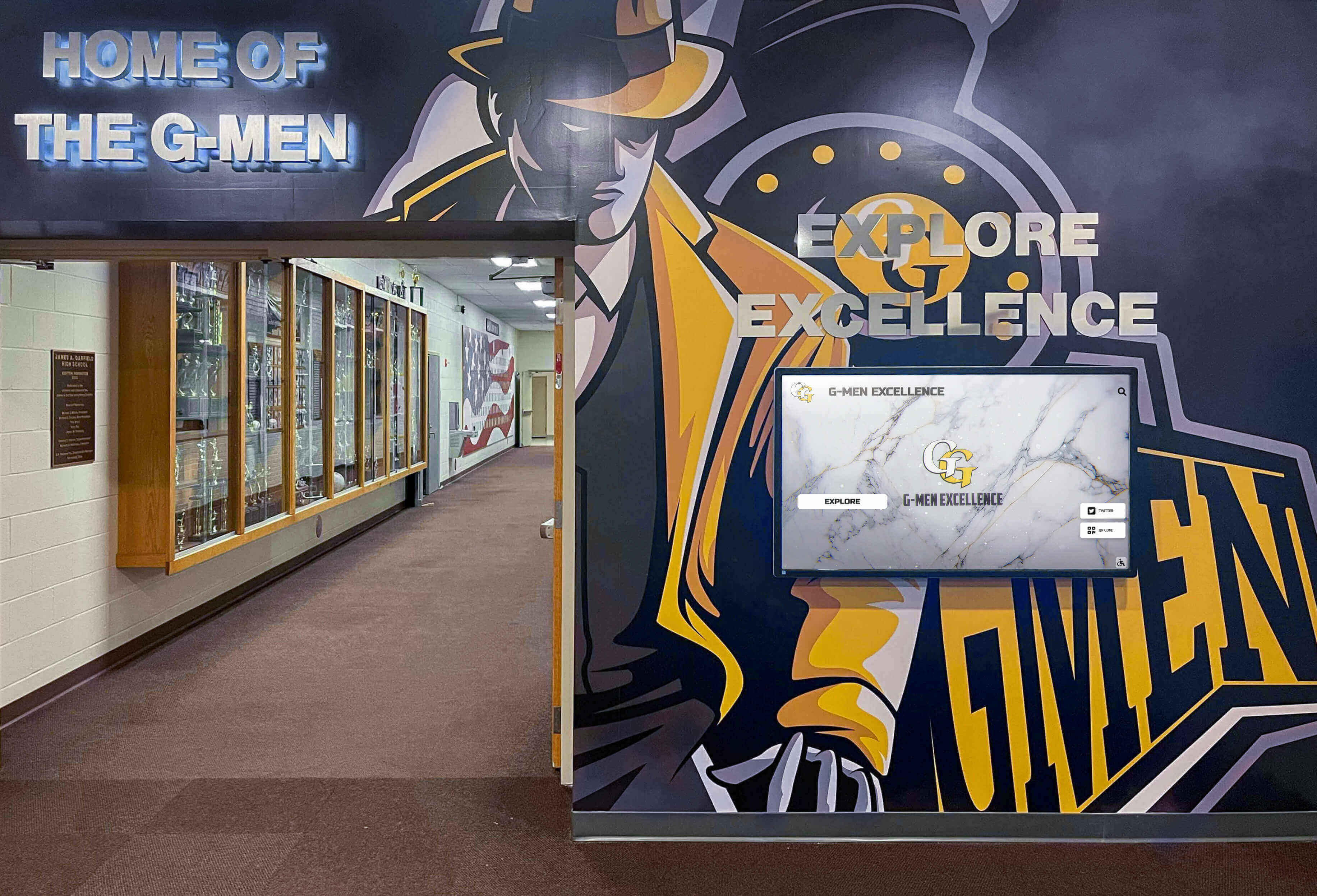
Strategic placement in high-traffic areas maximizes ongoing engagement with inductee recognition
Budget Considerations for Hall of Fame Programs
Understanding costs helps schools plan sustainable recognition programs.
Traditional Physical Display Costs
Physical recognition involves ongoing expenses:
- Custom plaques $75 to $300 per inductee depending on materials
- Display case construction $1,500 to $5,000 for quality installations
- Wall preparation and mounting $500 to $2,000
- Annual plaque orders for new inductee classes
- Maintenance and cleaning supplies
- Space expansion when displays fill existing areas
These costs accumulate as programs mature and annual classes expand recognition.
Digital Display System Investment
Digital systems involve different cost structures:
Initial Investment
- Commercial touchscreen displays $2,500 to $8,000 based on size
- Content management software implementation $1,000 to $3,000
- Installation and mounting services $500 to $2,000
- Initial content development for historical inductees $1,000 to $3,000
- Staff training and technical support typically included
Ongoing Costs
- Annual software subscription $500 to $3,000 depending on features
- Content updates managed by existing staff
- Minimal hardware maintenance with commercial displays
- No recurring plaque production costs
- Electricity costs minimal with modern efficient displays
Touchscreen recognition display systems typically prove more cost-effective long-term compared to traditional plaques requiring ongoing production.
Funding Strategies
Multiple sources support hall of fame programs:
Athletic Booster Support
- Annual fundraising events specifically supporting hall of fame
- Sponsorship of recognition technology
- Underwriting ceremony costs including venue and reception
- Long-term endowment providing sustainable funding
Alumni Contributions
- Reunion class gifts supporting recognition programs
- Individual donor campaigns tied to hall of fame establishment
- Major gifts from successful alumni
- Recognition of donors alongside athletic inductees
Budget Allocation
- Athletic department line items for recognition
- School district capital improvement funds for installations
- Technology budgets covering digital display systems
- Facilities maintenance supporting ongoing upkeep
Best Practices for Long-Term Program Success
Sustainable hall of fame programs require ongoing attention and management.
Administrative Responsibilities
Clear role assignment prevents programs from stagnating:
- Athletic director oversight providing strategic direction
- Selection committee coordination managing annual cycles
- Nomination collection and candidate research
- Ceremony planning and execution
- Display maintenance and content updates
- Communication with inductees and families
- Record keeping and historical documentation
Regular Program Assessment
Continuous improvement ensures ongoing effectiveness:
- Stakeholder satisfaction with nomination and selection
- Ceremony attendance and engagement trends
- Display system usage analytics and interaction patterns
- Alumni engagement measures linked to recognition
- Budget adequacy and funding source stability
- Equity in recognition across sports, genders, and eras
Schools treating hall of fame as living program requiring regular attention maintain more effective recognition than those treating it as completed project.
Technology Updates and Maintenance
Digital systems require periodic attention:
- Software updates maintaining security and functionality
- Content quality review ensuring accuracy
- Hardware inspection preventing technical issues
- Staff training as personnel changes
- User experience improvements based on analytics
- Integration with evolving school technology systems
Regular maintenance prevents technical problems undermining visitor experience.
Conclusion: Creating Meaningful Hall of Fame Programs
Hall of fame selection processes honor achievement through transparent criteria, diverse committees, and comprehensive evaluation procedures. When schools establish clear standards balancing athletic excellence with character requirements, involve representative committees preventing favoritism, and implement accessible nomination processes, they create recognition programs celebrating deserving individuals fairly.
Digital touchscreen displays transform how schools present inductee information. Single displays accommodate unlimited inductees, interactive interfaces enable engaging exploration, remote content management simplifies updates, and web accessibility extends recognition beyond physical locations. These capabilities eliminate space constraints forcing difficult decisions about which inductees remain visible.
Successful programs combine rigorous selection standards with engaging recognition creating traditions inspiring current students while honoring those who established excellence. Whether establishing new programs or enhancing existing recognition, schools benefit from systematic approaches balancing prestige with inclusivity, historical acknowledgment with contemporary achievement, and traditional values with modern technology.
Your school’s hall of fame deserves selection processes maintaining credibility while recognition displays preserve achievement meaningfully. Digital displays provide the capacity and functionality ensuring every deserving inductee receives ongoing visibility inspiring future generations pursuing their own excellence.
Ready to explore modern hall of fame display solutions that eliminate space constraints? Book a demo to see how interactive touchscreen systems transform institutional recognition.