The gym lobby is your school’s first impression for athletes, families, visiting teams, and community members. Whether visitors are passing through before a game or waiting for a ceremony to begin, they form opinions about your athletic program the moment they step inside—well before the opening whistle or tip-off. A thoughtfully designed entrance tells a story: who came before, what the program values, and where it is headed.
Yet many school gym lobbies remain an afterthought—a dusty trophy case, faded championship banners, and a hand-painted record board missing last season’s updates. These gym lobby ideas for schools are designed to help athletic directors, facilities managers, and administrators transform underused entry spaces into purposeful recognition environments that motivate current athletes, honor alumni, inform visitors, and acknowledge the sponsors who make programs possible.
A well-planned gym lobby accomplishes four things at once: it celebrates achievement, communicates information, builds community pride, and creates an atmosphere that separates programs that take recognition seriously from those that don’t. The ideas below are organized around those four functions—records, awards, schedules, and sponsors—so you can implement them selectively based on your available space, budget, and technology.
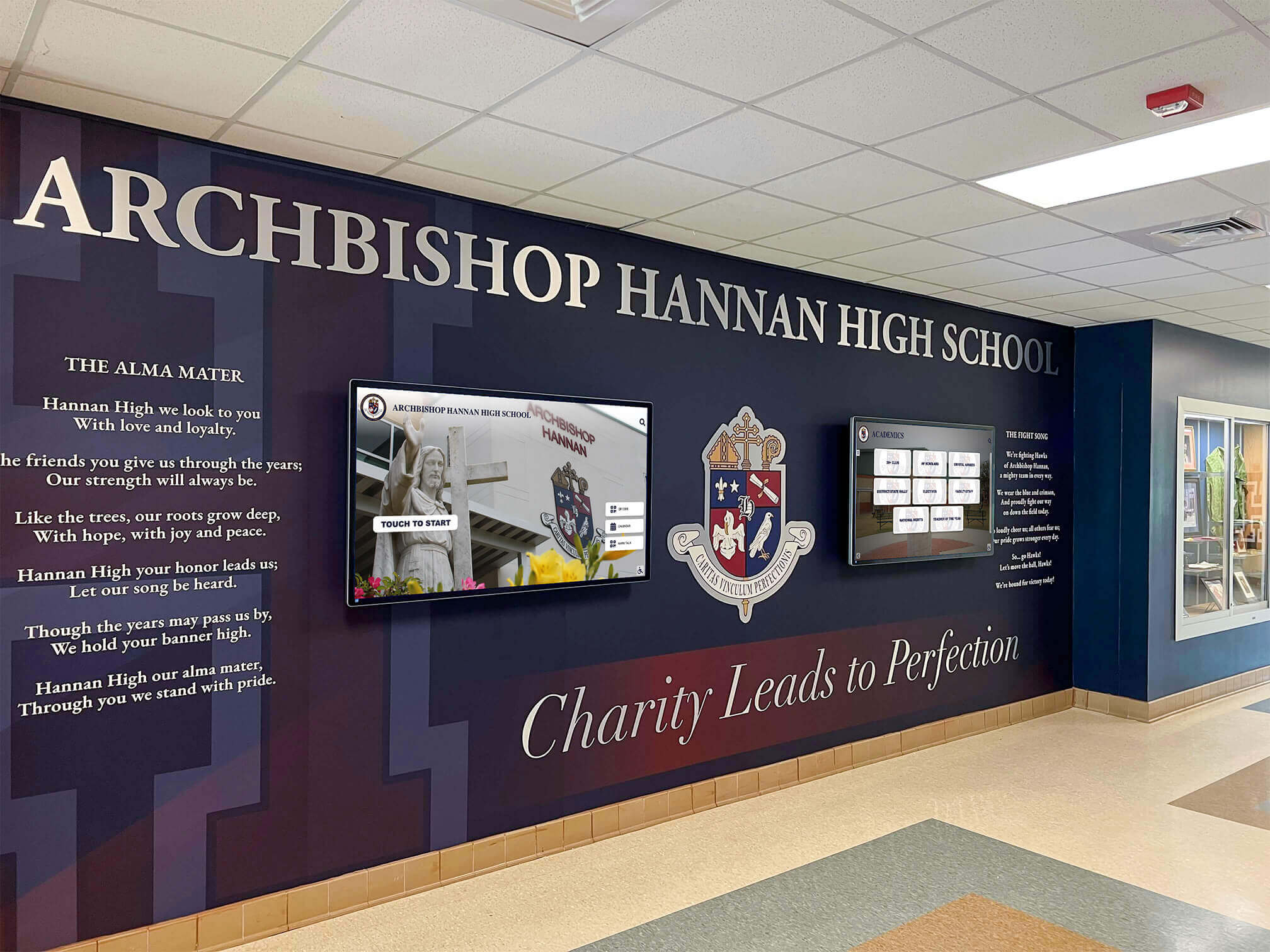
A layered gym lobby combines school identity elements—murals, crests, and colors—with dynamic digital displays that update automatically
Why Gym Lobby Design Matters for School Athletic Programs
The gym lobby functions as a de-facto welcome center for every athletic event. On a busy Friday night, hundreds of families, students, and community members pass through in minutes. Athletic directors who view that traffic as a communication and recognition opportunity consistently report higher alumni engagement, increased booster club participation, and stronger connections between current athletes and program tradition.
Physical space constraints are real—not every school has a grand entrance corridor. But even modest lobbies benefit from intentional planning. Understanding what content belongs in the space, how it should be presented, and whether static or digital solutions best fit your situation saves time and budget over the long run.
Academic recognition program design principles apply equally to athletic spaces: the most effective displays are organized, legible from a distance, and updated consistently so that visitors find new content on each visit.
30 Gym Lobby Ideas for Schools
The ideas below are grouped into four functional categories. Use them as a starting checklist when planning or renovating your school’s gym lobby space.
Records and Statistical Achievement Displays
- All-time athletic records board listing individual and team records by sport, event, and season
- Sport-specific records panels (separate boards for swimming, track, basketball, wrestling, etc.)
- Season-record history timeline showing win-loss records by year going back to program founding
- Career leaders leaderboard across multiple statistical categories per sport
- State qualifier and place-winner list documenting postseason achievements by athlete and year
- School records with automatic ranking so new records displace old ones without manual repainting
- Conference championship history banner or display panel counting titles by sport and decade
Athletic Awards and Recognition
- Athletic hall of fame inductee display with photos, graduation years, and brief achievement summaries
- All-conference and all-state recognition wall listing honorees by sport and year
- State championship banners or panels with rosters and season records
- Scholar-athlete recognition section bridging academic and athletic achievement
- Coach milestones display celebrating win totals, championships, and career tenure
- Championship trophy case with clearly labeled contextual information for each piece
- Retired jersey display with framed jerseys, numbers, and biographical context
- MVP and team award history list by sport, acknowledging individual recognition going back multiple decades
- Team photo archive display organized by sport and decade with digital browsing options
Schedule Boards and Event Information
- Season schedule board showing current home and away games for all varsity sports
- Postseason bracket display updated in real time during playoff runs
- Multi-sport event calendar combining all athletic events in a unified weekly view
- Athletic event countdown display showing days or hours until next home game
- Live score feed pulling from scoring systems during active home events
- Upcoming community events panel connecting booster club activities and fundraisers to lobby traffic
- QR code link to online schedule enabling visitors to add events to their personal calendars
Sponsor and Donor Recognition
- Presenting sponsor wall acknowledging lead sponsors with logo and contribution level
- Tiered booster recognition display organized by giving level (Gold, Silver, Bronze, or equivalent)
- Named facility acknowledgment panel recognizing donors who contributed to gym renovations or additions
- Equipment sponsor recognition linking specific gear, scoreboards, or systems to their funders
- Booster club founding member display honoring individuals who established program support infrastructure
- Annual sponsor recognition rotation on a digital screen cycling through active sponsors by season
- Scholarship recipient and donor pairing acknowledging both the student-athlete and the family or organization that funded the award
Static vs. Digital Gym Lobby Displays: Comparison at a Glance
Not every gym lobby element requires a screen, and not every record board needs to be painted on a wall. The table below compares static and digital approaches across the four content types, helping you determine where each solution fits best.
| Display Type | Static (Physical) | Digital (Screen-Based) |
|---|---|---|
| Records board | One-time fabrication; repaint or replace when broken | Updates instantly; auto-ranks new records |
| Awards display | Durable; no power required; limited space | Unlimited inductees; searchable; multimedia-capable |
| Schedule board | Manual update required; can lag behind changes | Automated feeds; real-time accuracy |
| Sponsor display | Fixed logos; changes require fabrication | Logos rotate; levels update without reprinting |
| Maintenance burden | Periodic cleaning; replacement when damaged | Remote CMS updates; no physical maintenance |
| Space requirement | Grows with each addition | One or two screens serve all content types |
| Initial cost | Lower per item; higher over time as items accumulate | Higher upfront; lower long-term replacement cost |
| ADA accessibility | Limited; small text often unreadable from distance | Adjustable font size; touch-accessible interfaces |
Day-to-day operations of school digital displays illustrate how staff manage content updates across these categories without requiring technical expertise.
Athletic Records Displays: Planning and Format Options
Records boards are among the most visited elements in any gym lobby. Parents compare their child’s statistics to program history. Visiting coaches scan records before games. Alumni pause to see whether their achievements remain on the board. The challenge is keeping this information current without consuming unreasonable staff time.
Static Records Boards
Traditional painted or printed records boards offer visual permanence—many communities appreciate the physical presence of a board that has hung on a wall for decades. Key planning considerations include:
- Event categories: Define which statistics merit a record entry before fabrication (prevents awkward additions later)
- Format legibility: Text must be readable at 10–15 feet; avoid cramped layouts with many records per line
- Update mechanism: Factor in repainting or vinyl overlay costs annually; some schools budget $200–$500 per update cycle
- Position accuracy: Ensure records reflect correct athletes before installation—corrections are costly
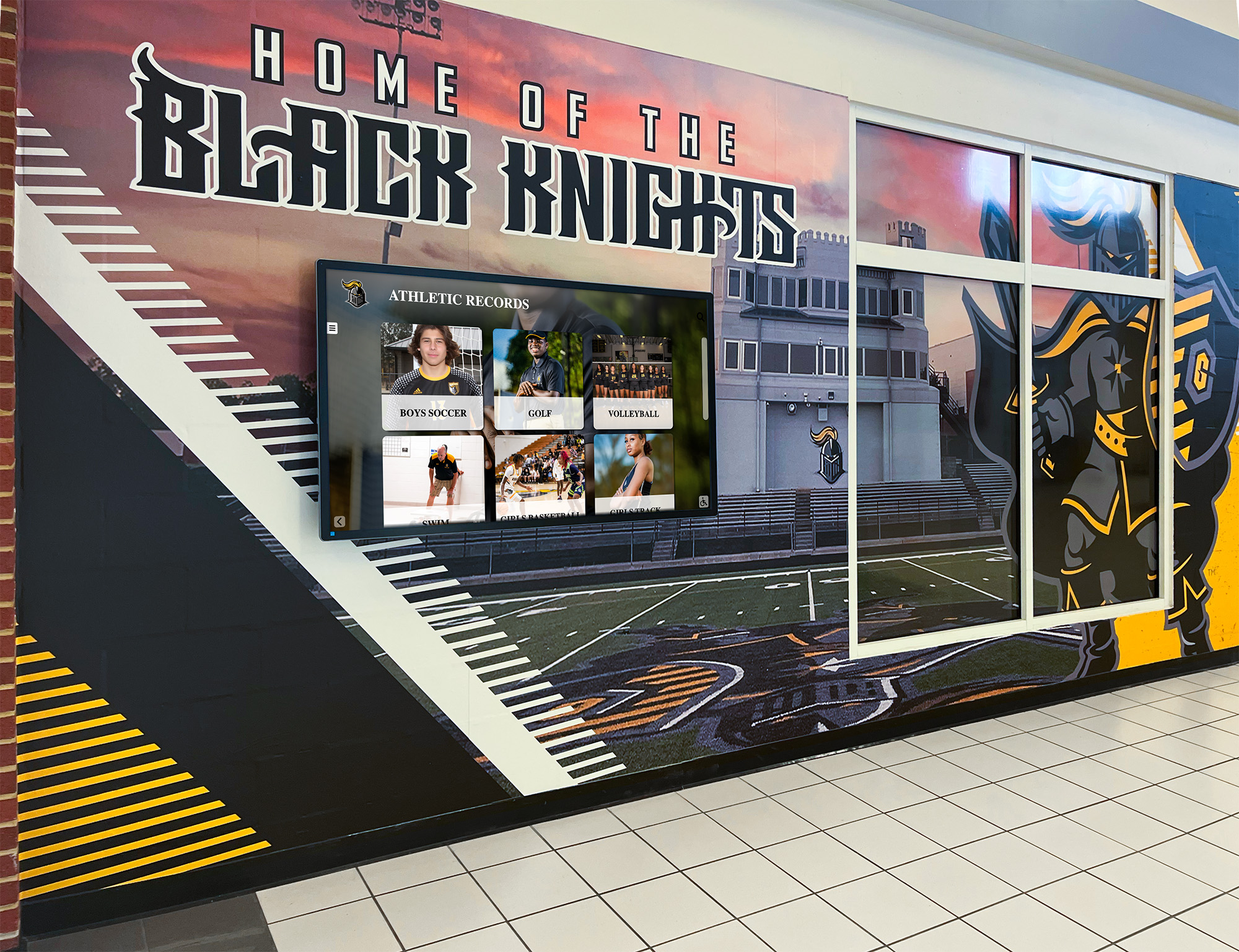
Combining a fixed mural with a digital records screen preserves institutional character while enabling real-time updates
Digital Records Boards
Touchscreen and digital display systems solve the core problems of static records boards: they update instantly, accommodate unlimited categories, and rank entries automatically when new records are set. Digital record board tools for athletics provide comprehensive evaluations of platforms designed specifically for school athletic programs.
Key features to evaluate when selecting digital records board software:
- Auto-ranking: Does the system automatically move new records to the top without manual reordering?
- Category flexibility: Can you add new statistical categories (three-point field goals, for example) without a software rebuild?
- Sport filtering: Can visitors filter records by sport, event type, or year range?
- Historical depth: Does the system retain all-time bests without truncating older records?
- Remote update access: Can athletic staff update records from the office or from a phone, without being physically at the display?
Schools with multiple sports programs often find that a single 65" digital display presenting organized, searchable records replaces five or six separate static boards—reducing wall clutter while expanding the information available to visitors.
Athletic Awards and Hall of Fame Displays
Award recognition in the gym lobby serves a distinct purpose from records boards: it celebrates the people behind the statistics, not just the numbers themselves. Inductees to school halls of fame, all-state honorees, and championship team members deserve displays that communicate biography, not just name and year.
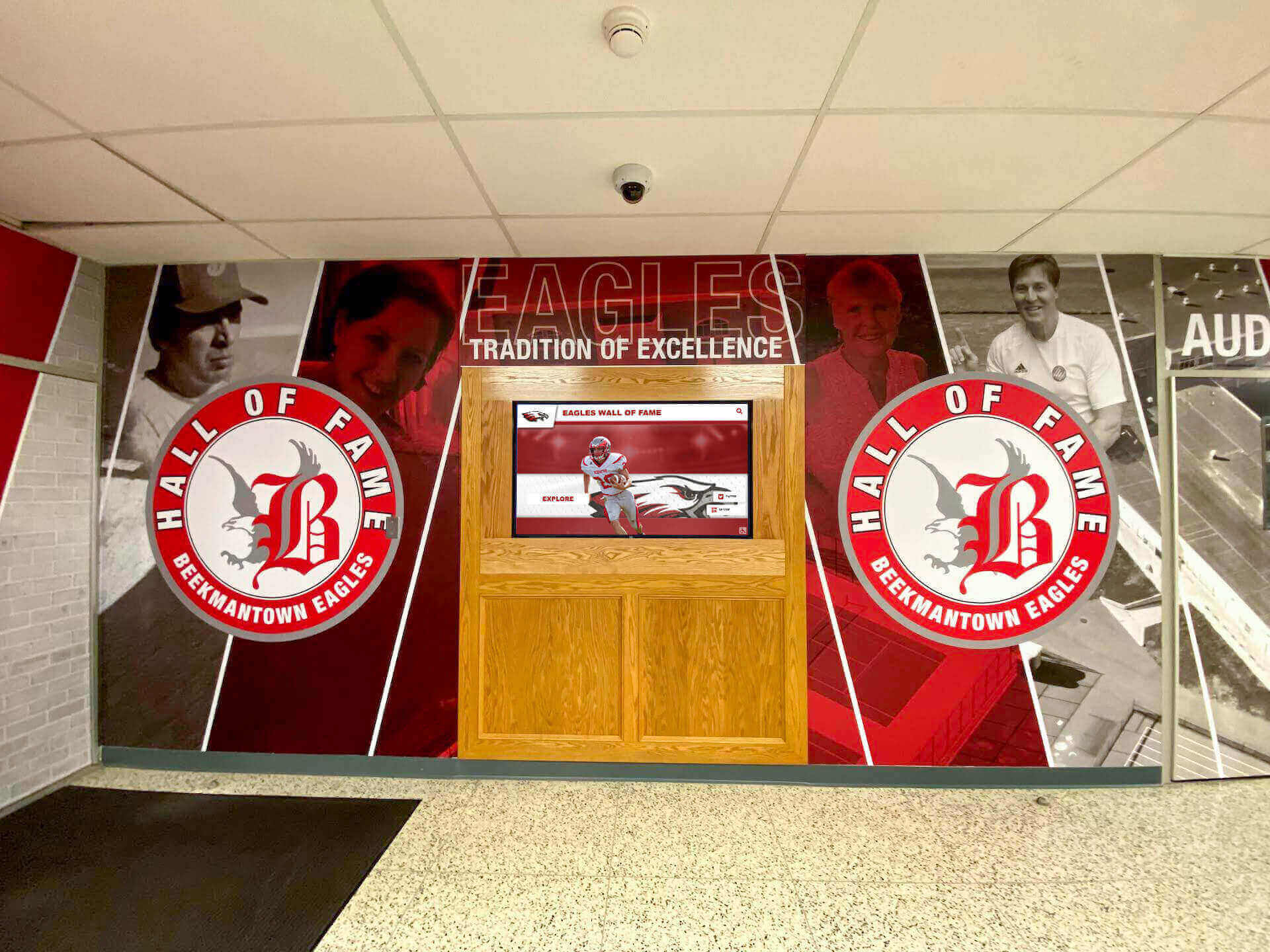
Murals with integrated recognition panels create immersive lobby environments that visitors explore rather than simply pass through
Structuring Award Recognition Content
Whether static or digital, award displays benefit from consistent structure:
- Inductee name and graduation year — foundational information enabling alumni to orient themselves
- Sport(s) and years of participation — context that distinguishes multi-sport athletes from single-sport standouts
- Key achievements — two to four bullet points summarizing what distinguished this individual
- Photo — humanizes the recognition; digital systems can display full photo galleries
- Post-graduation note — optional, but powerful: noting that an inductee went on to coach, teach, or serve the community reinforces program values
School academic and athletic award display strategies demonstrate how schools structure recognition content across both academic and athletic domains to maintain consistent visual standards throughout buildings.
Hybrid Award Display Approaches
Many schools combine static and digital elements effectively:
- Permanent plaque wall acknowledging each hall of fame class by year, providing physical permanence
- Digital touchscreen adjacent to the plaque wall, allowing visitors to explore full inductee profiles with photos, videos, and career narratives
- QR code on physical plaques linking to extended online profiles accessible via smartphone
This layered approach satisfies community members who value the tangibility of physical recognition while extending the depth and interactivity that digital systems provide.
Academic achievement award program design offers frameworks applicable to athletic recognition, particularly around consistent criteria, nomination processes, and display standards.
Schedule Boards and Event Information Displays
Schedule boards in gym lobbies serve time-sensitive communication needs. Visitors arriving for events need to quickly find which gym court a game is in, when junior varsity plays before varsity, and what events are coming up in future weeks.
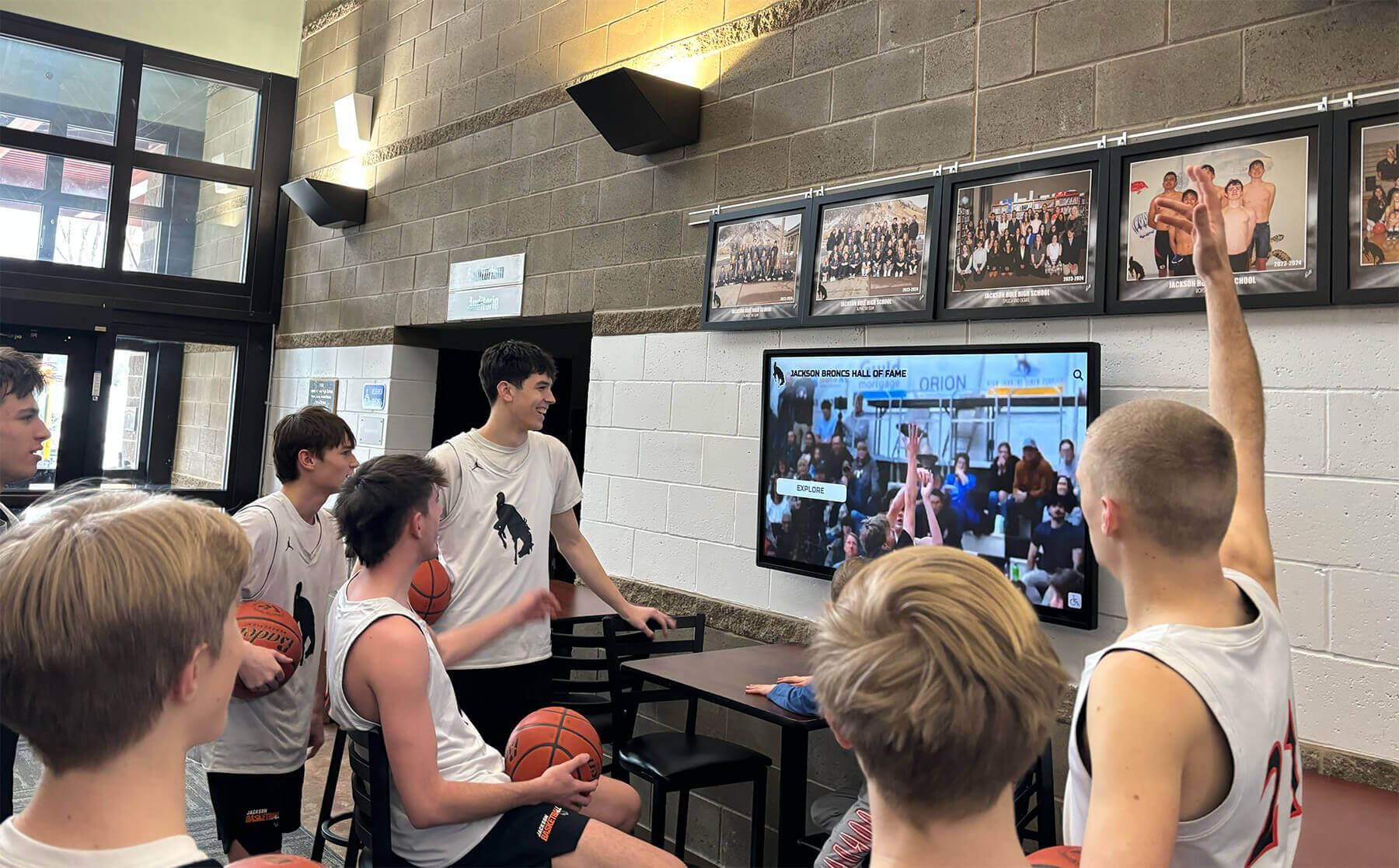
Digital screens in gym lobbies serve current athletes and visitors simultaneously—providing recognition, highlights, and event information in one display
Static Schedule Displays
Printed season schedules work for many programs, particularly those with limited budgets or low-frequency display needs. Best practices for static schedule boards include:
- Date, opponent, location, and time for every event on the schedule
- Home vs. away designation clearly marked (ideally with different colors or icons)
- Sport logo or icon distinguishing schedules across multiple sports displayed together
- “Current week” marker that a staff member updates weekly—a simple sticker or magnetic indicator reduces the cognitive load of scanning a full schedule
Digital Schedule Boards
Digital schedule displays connected to athletic scheduling systems update automatically when schedules change—eliminating the lag between a rescheduled game and updated lobby communication. Features worth evaluating:
- Real-time sync: Does the schedule board pull from the same source as the school’s website and app?
- Multi-sport view: Can visitors filter by sport, or does the board cycle through all sports in sequence?
- Event countdown: Does the board automatically calculate and display days until the next home game?
- Broadcast capability: Can the display show live scores during active events?
Digital signage content ideas for screens and kiosks include schedule boards as a core category alongside recognition content—many schools benefit from combining both on the same display through content rotation.
Sponsor and Donor Recognition Displays
Sponsor recognition in the gym lobby closes the loop between program funding and community visibility. Sponsors who see their name or logo prominently displayed during events—rather than only on a website few parents visit—renew at higher rates and at higher giving levels. The lobby is among the highest-traffic areas in the building, making it an ideal location for acknowledgment.
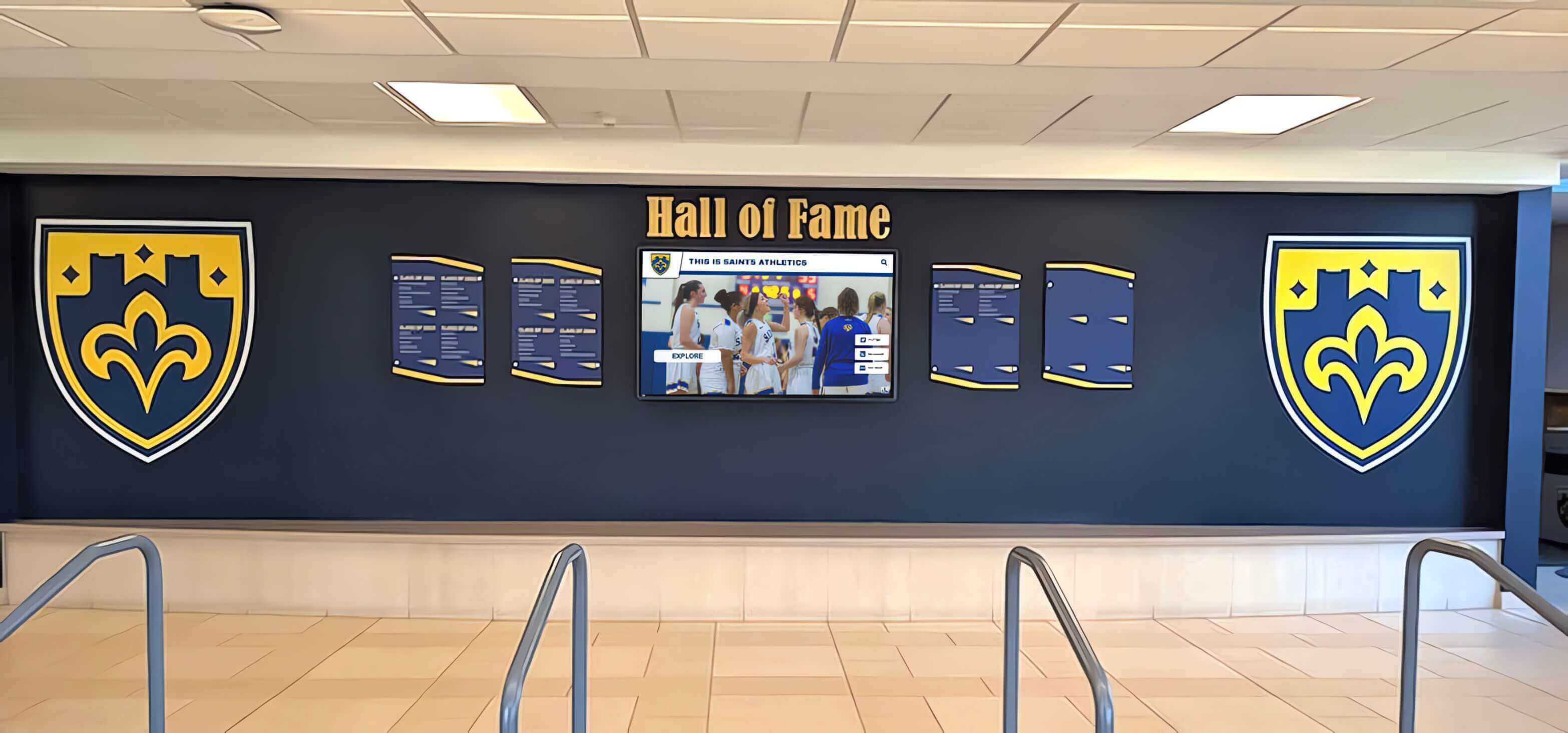
Recognition walls that blend physical elements with screens accommodate both permanent sponsor plaques and rotating digital acknowledgment
Structuring Sponsor Recognition Tiers
Tiered recognition programs give sponsors clear expectations and incentivize upgrades:
Presenting Sponsor (top tier)
- Prominent logo placement near the gym entrance
- Name on all printed event programs and digital schedules
- Recognition from announcer at home events
- Dedicated sponsor profile on digital lobby display
Supporting Sponsors (middle tier)
- Logo included in digital sponsor rotation
- Name on selected printed materials
- Recognition at end-of-season athletic banquet
Community Sponsors (entry level)
- Name listed in program materials
- Inclusion in digital sponsor roster on lobby display
Youth sports award and recognition ideas include sponsor recognition frameworks alongside athlete awards, reflecting how programs treat acknowledgment of funders alongside achievement recognition.
Digital Sponsor Displays
Digital screens dedicated to sponsor acknowledgment cycle through logos, sponsor names, and giving level designations automatically. When a sponsor relationship changes—new partner, upgraded tier, or renewal—the CMS update takes minutes rather than requiring new fabricated signage. This flexibility makes digital sponsor displays particularly valuable for programs whose sponsor rosters shift from season to season.
Key content for a digital sponsor rotation:
- Logo (high resolution, provided by sponsor)
- Business name and tagline (one line, sponsor-approved)
- Giving level or sponsorship title (“Presented by” / “Supported by”)
- Years of support — “Proud sponsor since 2015” builds narrative around long-term relationships
- Call to action for prospective sponsors: “Interested in supporting [School] Athletics? Contact [AD Name]”
Planning Your Gym Lobby Display: Implementation Considerations
Transforming gym lobby ideas into installed displays requires decisions about hardware, software, and physical placement. A few implementation principles apply across all the content categories above.
Space and Traffic Flow
Displays should be positioned where visitors naturally pause, not in paths of active foot traffic. Common effective locations include:
- Adjacent to ticket windows or entry doors — where visitors slow down before entering
- Along a dedicated recognition corridor — a hallway leading from the lobby to the gymnasium entrance
- Near trophy cases — clustering recognition content creates a defined “heritage zone”
Avoid placing displays in corners visitors never approach, at heights requiring visitors to crane their necks, or in areas with strong natural light that creates screen glare.
Hardware Selection Considerations
Commercial-grade screens rated for eight or more hours of daily operation outperform consumer televisions in gym lobby environments. Key specifications to evaluate:
- Screen size: 55" to 75" covers most gym lobby viewing distances of 8–20 feet
- Brightness: 400–700 nits handles ambient light in most school lobbies; high-brightness panels (700+ nits) for lobbies with significant natural light
- Touchscreen: Interactive touch capability enables the visitor self-exploration that drives engagement; not required for schedule or sponsor displays
- Mounting: Wall mounts, floor kiosks, and freestanding enclosures each suit different spaces
Evaluating hall of fame tools across athletics, donors, and arts provides a broader framework for assessing digital display platforms beyond records alone—useful when a school wants one system to serve multiple lobby functions.
Content Governance and Update Responsibilities
The most common failure mode for gym lobby displays—static or digital—is letting content grow stale. Assign clear ownership before installation:
- Athletic director: Approves new inductees, sponsor additions, and content policy
- Athletic secretary or administrative assistant: Handles routine updates (schedule changes, new records, sponsor renewals)
- IT coordinator: Manages hardware, network connectivity, and software access
- Student assistants: Some programs successfully involve student athletic council members in content collection and photography
Athletic director transition planning addresses how to document display management responsibilities so institutional knowledge transfers when key personnel change—a critical consideration for programs with complex lobby installations.
Connecting the Lobby to Broader Recognition Programs
The gym lobby should not exist in isolation from a school’s broader recognition infrastructure. Academic decathlon and scholar recognition programs benefit from the same display frameworks as athletic programs—some schools integrate both in shared lobby spaces to reinforce a unified culture of achievement.
Similarly, lobby displays that connect to web-accessible content—where visiting alumni can browse inductee profiles from home after an event—extend recognition well beyond the physical space. Academic All-American award criteria and recognition exemplifies the kind of multi-dimensional achievement that deserves recognition both in the lobby and online.
Frequently Asked Questions
How many displays does a gym lobby need?
Most school gym lobbies function well with one to three displays: one for records and awards recognition, one for schedules and event information, and one for sponsor acknowledgment. Schools with budget constraints often start with a single display cycling through all three content types.
What’s the difference between a digital records board and a general digital sign?
A records board is a specialized display designed to present ranked athletic records, auto-sort when new records are set, and organize entries by sport and category. General digital signs require manual reordering and typically lack the sport-specific structure athletic records require.
Can a gym lobby display also connect to web visitors?
Yes. Most modern display platforms publish content to a web URL simultaneously, allowing alumni or parents who weren’t at an event to browse recognition content from home. QR codes on the physical display provide a direct path.
How do schools fund gym lobby display upgrades?
Common funding sources include booster club campaigns, presenting sponsor contributions, district technology budgets, and capital improvement funds. Some schools successfully position a major display upgrade as a naming opportunity—“The [Sponsor Name] Recognition Center”—creating a major gift ask that covers substantial installation costs.
How often should lobby content be updated?
Records boards: immediately when records are broken. Award displays: after each induction cycle (typically annually). Schedule boards: at the start of each season and whenever games are rescheduled. Sponsor displays: at the start of each school year when sponsor rosters are confirmed.
Bringing Your Gym Lobby Ideas to Life
The gym lobby represents one of the most consistent communication opportunities a school athletic program has—hundreds of visitors, multiple times per week, primed to engage with information about the program they’ve come to support. Whether you implement a single updated records board or design a comprehensive recognition corridor with digital displays, awards panels, schedule boards, and sponsor acknowledgment, the investment pays dividends in community connection, alumni engagement, and athlete motivation.
The most effective gym lobbies are not built all at once. Start with the highest-traffic element your budget supports—often a digital records and awards display that consolidates multiple aging static boards into one regularly updated screen. Add schedule and sponsor components as budget allows. Document content responsibilities clearly so displays stay current regardless of staffing changes.
When you’re ready to explore interactive touchscreen solutions that handle records, awards, schedules, and sponsor displays within a single platform, request a demo from Rocket Alumni Solutions to see how schools use these tools to transform their gym lobbies without requiring ongoing technical support.