Intent: define — This guide explains what a dance team is, why recognition matters, and how schools can celebrate performance squads with both traditional programs and modern touchscreen display technology.
A school dance team is one of the most visible performance programs on campus, yet recognition for these athletes often lags behind traditional sports. Dance team members train for hundreds of hours, compete at regional and national levels, and represent their schools at games, assemblies, and community events—yet their achievements are rarely honored with the same permanence as a football MVP plaque or a swim-team record board. This guide walks administrators, coaches, and activity directors through the full spectrum of dance team recognition: from seasonal award ceremonies to permanent digital displays that celebrate performance squads year-round.
A strong recognition program does more than thank athletes after a season ends. It signals to current members, incoming students, and the broader community that the program has a history worth honoring—and a future worth joining. For dance teams specifically, where recruiting new members each year is critical to sustaining energy and depth, visible recognition directly supports program growth.
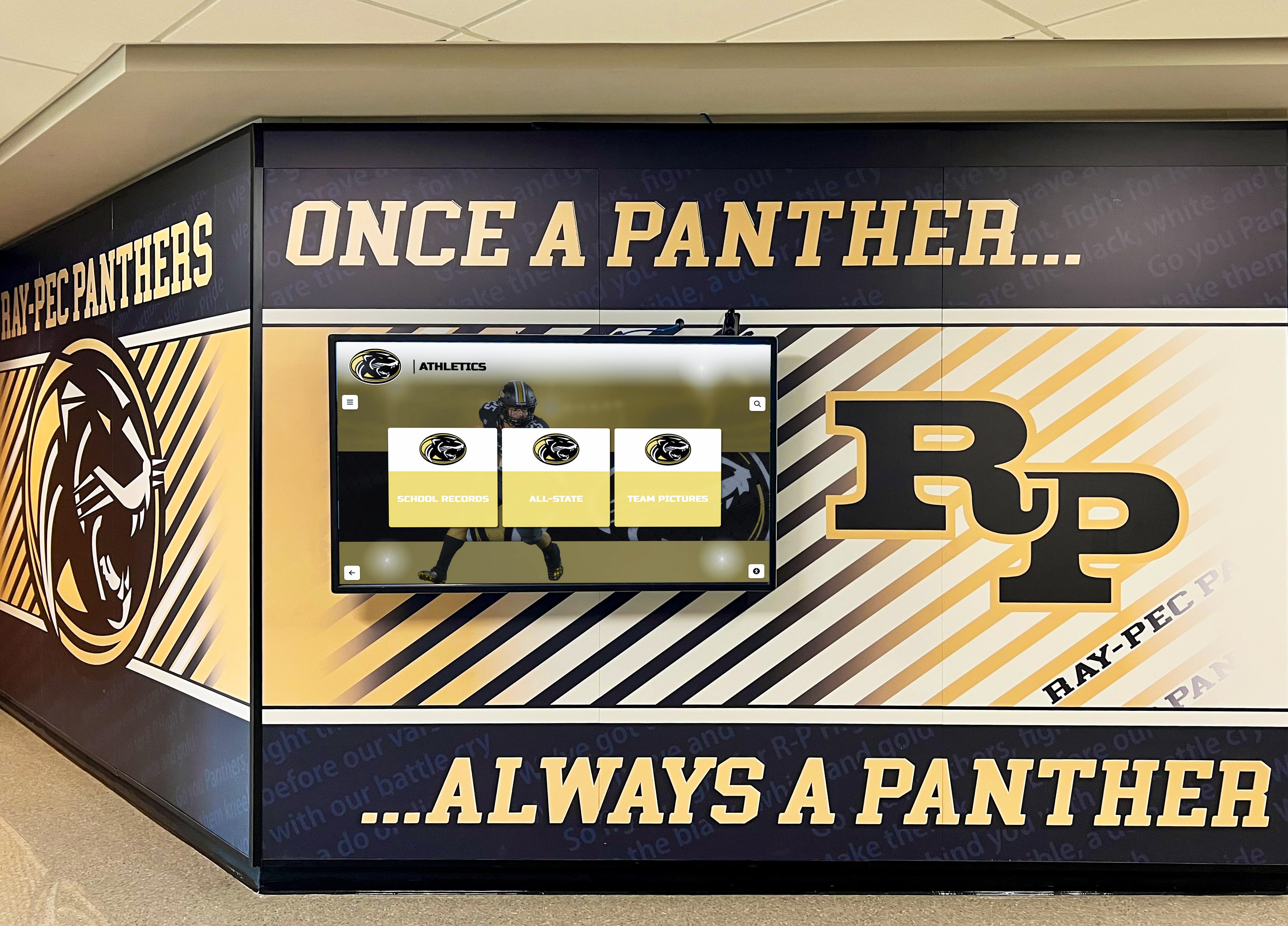
Permanent hallway displays give performance squads the same visibility as traditional athletic programs
What Is a Dance Team? Defining the Program for Recognition Purposes
Before designing a recognition system, it helps to understand the structure of a typical school dance team and what achievements are worth celebrating.
Core Roles and Team Structures
School dance teams generally fall into several overlapping categories:
- Competitive dance teams that enter regional and state-level dance competitions judged on technique, choreography, difficulty, and performance quality
- Pom or spirit squads that perform at athletic events, pep rallies, and school assemblies, focusing on school spirit and entertainment
- Drill teams common in Texas and other Southern states, functioning as precision marching performance squads tied to halftime shows
- Show choirs and dance-integrated performance groups where movement is central to the program but blends with vocal performance
In most schools, the dance team operates under the athletic or activities department, meaning its members are often held to the same eligibility, attendance, and academic standards as traditional athletes. Yet their recognition infrastructure—record boards, display cases, hall of fame panels—often doesn’t reflect that equivalence.
What Achievements Deserve Display
Dance team recognition programs should capture a wide range of accomplishments:
- Competition placements (regional, state, national)
- Performance records (most consecutive appearances, highest competition score)
- Individual honors (dancer of the year, rookie of the year, captain designations)
- Choreographer recognition
- Academic achievement among team members
- Long-tenured members and multi-year captains
- Alumni who went on to college programs or professional performance careers
- Community service contributions tied to performances
Recognition programs that account for non-traditional athletic squads often see the highest engagement because they reflect the full breadth of a school’s talent rather than only its varsity sports wins.
Why Dance Team Recognition Matters for Schools
Recognition is not just about thanking departing seniors. It serves practical institutional functions that benefit the program directly.
Retention and Recruiting
Incoming students and their families evaluate a program’s culture before committing. A visible dance team display—photographs of past competitions, a roster of award recipients, a touchscreen profile of standout performers—communicates investment and seriousness. Programs that look established attract more serious candidates.
Student leadership programs consistently report that visible recognition infrastructure correlates with higher student interest in joining performance and arts programs. The logic applies directly to dance teams: when students can see that the program preserves its history and honors its members, they are more likely to audition.
Equity with Traditional Sports Programs
Many schools have devoted considerable resources to athletic recognition: football record boards, basketball hall of fame panels, swimming time boards. Dance teams that perform at those same athletic events, and compete with the same level of seriousness, deserve comparable visibility. A unified digital display system that includes dance alongside traditional sports sends a clear equity signal to the student body and parent community.
Alumni Connection
Dance team alumni who feel recognized are more likely to stay connected to a school’s booster infrastructure, attend alumni events, and contribute financially as donors over time. Recognition is the foundation of alumni engagement. A display that preserves a graduate’s name and achievement from fifteen years ago remains meaningful to that person decades later.
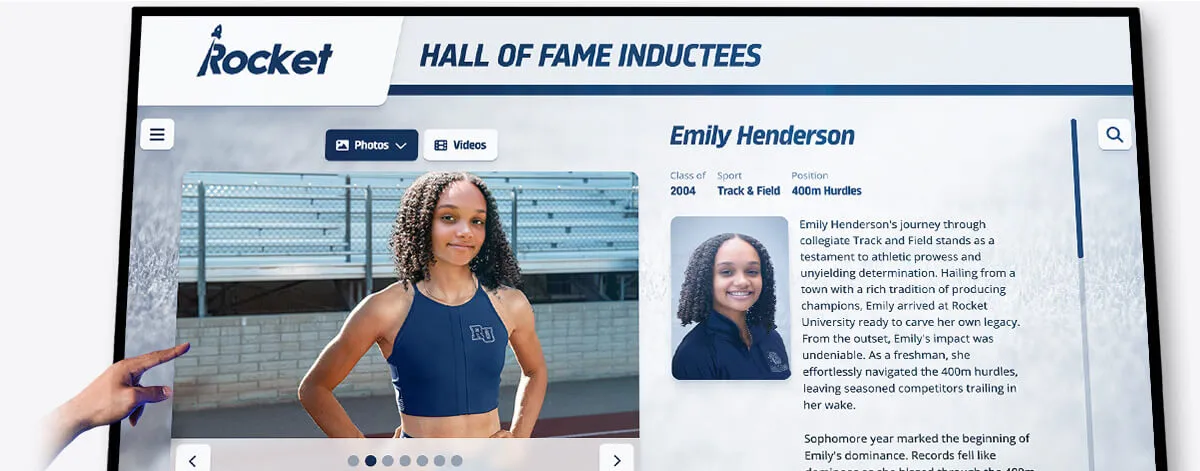
Individual achievement profiles on interactive displays honor performers the same way traditional sports record boards do
Traditional Dance Team Recognition Approaches
Most schools already use some combination of these methods. Understanding their strengths and limitations helps evaluate where digital solutions add the most value.
End-of-Season Award Ceremonies
The end-of-year banquet or awards assembly is the most common dance team recognition event. Coaches present awards, seniors are acknowledged, and the season’s highlights are reviewed. Done well, these ceremonies are meaningful. Their limitation is that they are ephemeral—a single evening that most of the school community never attends.
Common award categories for dance team programs include:
- Most Valuable Dancer — overall excellence in technique, performance, and leadership
- Most Improved — strongest growth arc from tryouts through the final competition
- Rookie of the Year — standout first-year member
- Captain’s Award — leadership and culture impact
- Choreography Award — recognizing members who contribute to creating routines
- Scholar-Athlete Award — combining academic and performance achievement
- Coach’s Award — personal selection for attitude, effort, and team-first mentality
Sport-specific end-of-year awards programs provide additional frameworks adaptable to performance-based programs like dance teams.
Physical Trophy Cases and Plaques
Many dance programs maintain a dedicated display case with trophies from competitions, framed team photos, and individual plaques. These physical displays carry genuine weight—they occupy visible real estate in the school building and communicate permanence.
The practical limitations are well known to any administrator who has managed one:
- Space fills up quickly, forcing older achievements out of visibility
- Updates require physical production (engraving, printing, framing) which takes time and budget
- Content is static and cannot include video, multimedia, or dynamic updates
- Accessibility is limited to people physically present at that location
Social Media and School Website Recognition
Many programs now supplement physical displays with Instagram, Twitter/X, and TikTok posts celebrating competition results, individual achievements, and team milestones. Social media recognition is immediate and reaches a wide audience, but it disappears into feeds quickly and provides no permanent, searchable record.
School website pages for the dance team can serve as a more durable complement, but they typically require IT department involvement to update and rarely include the depth of historical content that a dedicated recognition platform provides.
Modern Digital Display Options for Dance Team Recognition
The shift toward interactive touchscreen displays has created new options for schools that want recognition infrastructure matching the depth and dynamism of what their dance teams actually do.
Digital Record Boards and Performance Leaderboards
For competitive dance teams, a digital record board functions similarly to a swim-team time board: it displays the program’s best competition scores, highest placements, and performance records in a format that updates easily as new results come in. Unlike physical plaques, digital boards can be updated remotely through a content management system (CMS) without requiring new hardware or engraving.
Typical fields for a dance team digital record board might include:
- Competition name and date
- Score or placement
- Division (varsity, JV, pom, hip-hop, jazz, etc.)
- Team member roster for that year
- Coach at the time of the achievement
Interactive Touchscreen Kiosks and Hall of Fame Panels
Larger schools with robust dance programs—or those managing multiple performance squads—often benefit from a full interactive touchscreen installation. These systems allow visitors to browse individual dancer profiles, view photos and video clips from past performances, explore competition histories by year, and access complete team rosters going back multiple seasons.
Key features to evaluate when comparing interactive display options for a dance team:
Content capacity — Some platforms cap the number of entries or profiles; others offer unlimited storage. A dance program with decades of history needs unlimited capacity to avoid losing older records.
Media support — Dance recognition benefits greatly from video. Look for platforms that can embed performance clips, not just static photos.
Remote CMS access — Coaches and administrators should be able to update content without requiring IT support or on-site technical visits. Cloud-based platforms allow updates from any device.
ADA compliance — The Americans with Disabilities Act (ADA) requires that public-facing displays in educational settings meet WCAG 2.1 AA accessibility standards. This includes sufficient contrast ratios, screen reader compatibility, and adjustable text sizing.
Hardware size options — Interactive kiosk displays commonly come in 55-inch, 65-inch, 75-inch, and 86-inch configurations. The right size depends on the installation space and expected foot traffic.
QR code and multi-device access — The most flexible systems generate QR codes that visitors can scan to access the full dance team recognition content on their phones, extending reach far beyond the physical display location.
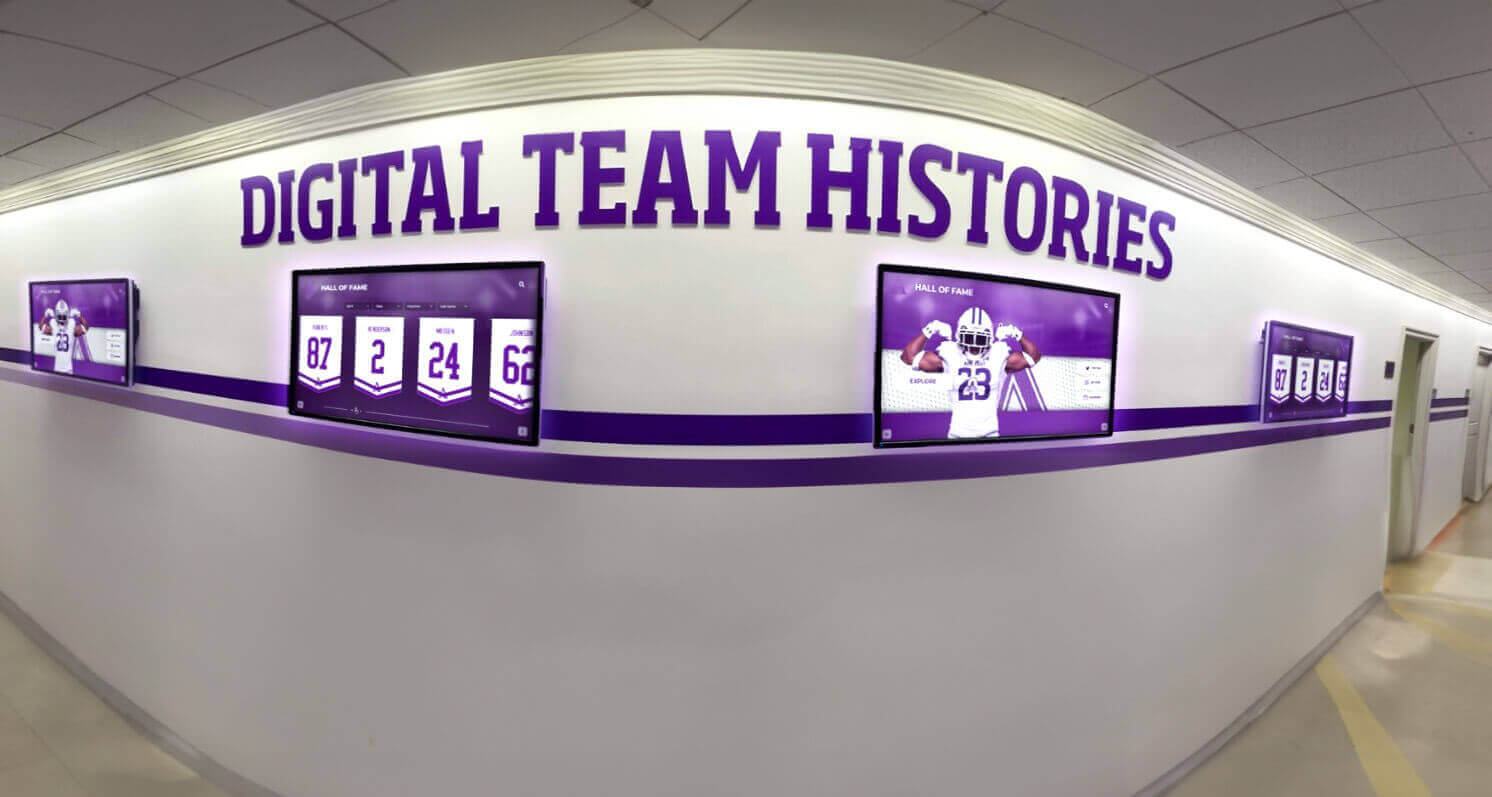
Multi-screen hallway installations allow schools to recognize multiple programs including dance teams simultaneously
Digital storytelling approaches for athletic and performance programs explain how schools can structure narrative content within interactive platforms to preserve program culture across generations.
Digital Trophy Walls and Hall of Fame Displays
A dedicated digital trophy wall for a dance team functions as a permanent, updatable hall of fame. Unlike a static plaque panel, it can feature:
- Rotating photos from recent performances
- Highlighted annual award recipients with photos and brief descriptions
- A searchable archive of all past team members
- Competition history with scores and placements
- Embedded video performances
These installations work especially well in performing arts wings, gymnasiums used for dance competitions, or main school lobbies where foot traffic includes parents, alumni, and visitors who may not be aware of the program’s competitive success.
Planning a Dance Team Recognition Display: Implementation Considerations
Where to Install
Placement matters as much as the technology itself. High-traffic locations near the gymnasium entrance, performing arts wing, or main lobby give dance team recognition the same visibility as football and basketball programs often receive. Some schools co-locate dance team displays within a broader athletic hall of fame, ensuring equity across all programs.
Informational and interactive display planning for schools provides guidance on selecting installation locations that maximize engagement across diverse student populations.
Content Preparation
Before installing any display system, gathering historical content is the most time-consuming step. Recommended preparation tasks:
- Compile competition results with dates, divisions, and placements going back as far as records allow
- Collect team photos organized by year
- Identify key award recipients and gather individual photos and brief bios
- Locate any existing video performance footage
- Interview long-tenured coaches or alumni to capture institutional memory not preserved in paper records
Budget and Timeline Expectations
Display implementations typically fall into three budget tiers:
- Entry-level digital signage (under $2,000): Non-interactive displays showing rotating images and text. Easy to update but no touch functionality or deep content browsing.
- Mid-range interactive kiosks ($3,000–$8,000): Single touchscreen with basic CMS, suitable for smaller programs. Supports photos, some video, and searchable profiles.
- Full hall of fame systems ($8,000–$20,000+): Multi-screen, multi-location deployments with full CMS, unlimited content capacity, QR code access, and ADA-compliant hardware.
Installation timelines range from a few weeks for simple digital signage to two to four months for custom-designed interactive hall of fame systems including content migration.
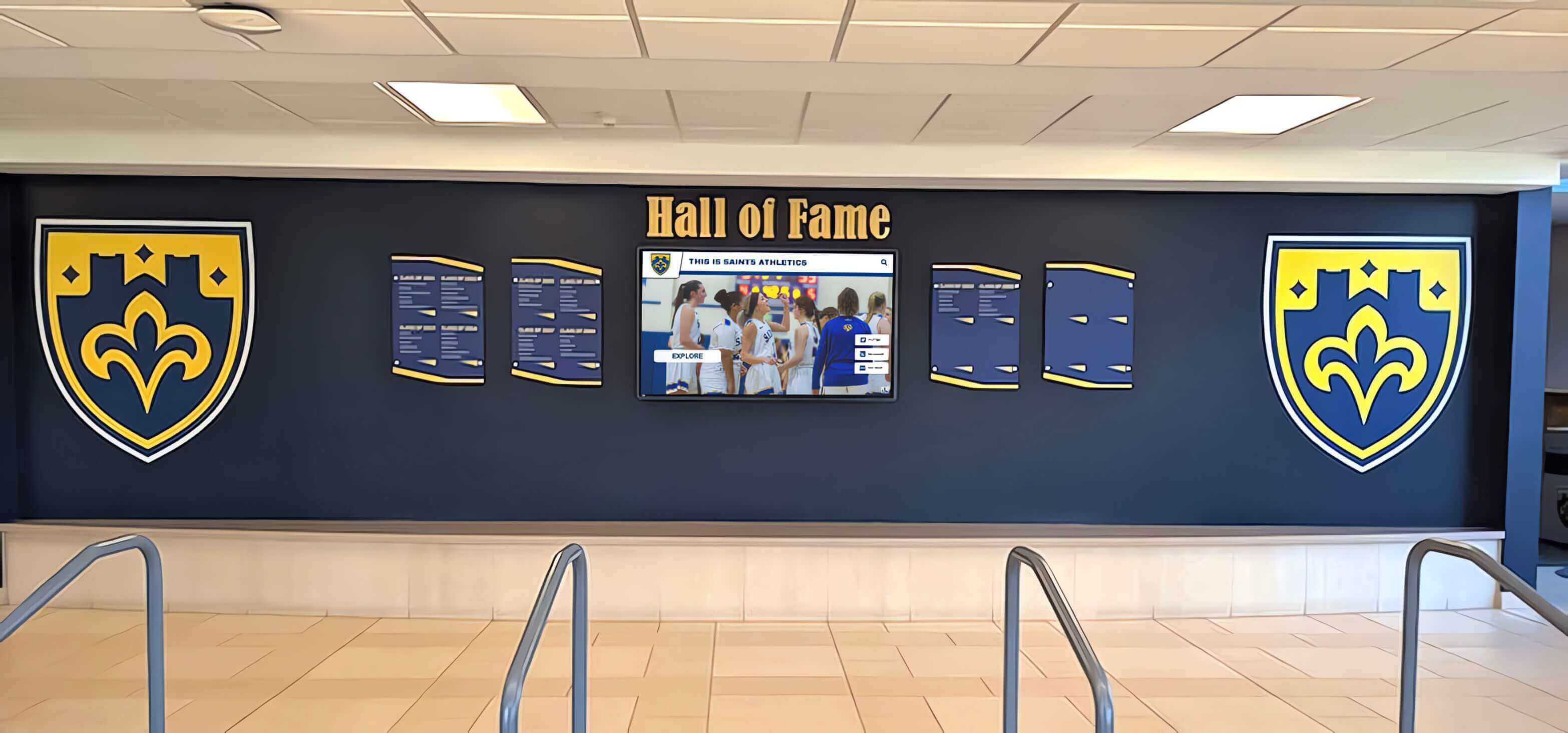
Combined physical and digital recognition installations honor program history while enabling ongoing updates
Sports awards ideas resources offer additional context for designing award categories that translate well to both physical presentation and digital display.
Integrating Dance Team Recognition with Broader School Programs
Dance team recognition doesn’t need to exist in isolation. The most effective school recognition environments integrate performance program displays alongside traditional athletic halls of fame, academic achievement boards, and community recognition panels. This approach:
- Reinforces a school culture that values multiple forms of excellence
- Reduces per-program installation costs by sharing hardware across departments
- Creates richer content libraries that alumni and community members find more compelling to explore
A touchscreen system covering athletics, arts, academic achievement, and community service in a single interactive interface provides far more return on investment than isolated program-by-program installations.
FAQ: Dance Team Recognition Displays
What types of schools benefit most from dance team recognition displays?
High schools with active competitive dance programs and middle schools looking to build culture around their performance arts typically see the most benefit. However, any school where dance team members represent the school publicly—at games, parades, assemblies, or competitions—has an institutional interest in preserving that history visibly.
Can a digital display system handle non-athletic performance programs like show choir or drama?
Yes. Most modern cloud-based recognition platforms are content-agnostic, meaning administrators can create custom sections for any program type. A single touchscreen installation can serve as the central recognition hub for athletics, performing arts, academics, and alumni.
How does ADA compliance work for touchscreen recognition displays?
ADA-compliant touchscreen displays for educational settings typically meet WCAG 2.1 AA standards, which require minimum contrast ratios between text and background, text scaling without loss of functionality, and alternative navigation methods for users with mobility limitations. Many platforms also offer web-accessible versions of their content accessible from any device, extending reach to users who cannot physically interact with a mounted kiosk.
How often does a dance team recognition display need to be updated?
Most programs update their displays once or twice per year: after competition season concludes and at the end of the school year when annual awards are finalized. Cloud-based CMS platforms allow authorized users to make updates remotely in minutes, so the ongoing maintenance burden is typically minimal.
What size touchscreen works best for a dance team recognition installation?
For a hallway or lobby installation intended for individual browsing, a 55-inch or 65-inch display is common. For a statement installation in a gymnasium or performing arts center visible to larger audiences, 75-inch or 86-inch configurations provide better visibility from a distance. Hardware suppliers typically offer site assessment services to recommend appropriate sizes based on installation space dimensions.
How long does it take to migrate historical content into a digital system?
This depends almost entirely on how well-organized existing records are. Programs with digital archives (spreadsheets, photo folders, existing websites) can often migrate content in one to two weeks. Programs starting from physical records, old yearbooks, or oral history may need six to eight weeks of content preparation before a display can go live.
Conclusion: Giving Dance Teams the Recognition They Deserve
A school dance team invests the same level of dedication, discipline, and competitive intensity as any varsity athletic program—and the recognition infrastructure supporting it should reflect that. From thoughtfully designed seasonal award ceremonies to permanent digital displays that preserve competition histories, individual achievement profiles, and performance highlights, schools have more tools available today than ever before to honor their performance squads in ways that last.
The shift toward interactive touchscreen platforms has made it practical and cost-effective for schools of any size to build recognition environments that include dance teams alongside traditional sports. When those displays are visible in high-traffic areas, updated regularly through accessible cloud-based CMS tools, and designed to meet ADA accessibility standards, they serve the full school community—current students, alumni, families, and visitors—for years to come.
Ready to explore what a permanent digital recognition display for your dance team or performance program would look like? Rocket Alumni Solutions helps schools build interactive recognition systems that honor every program—athletic, performing arts, and academic—with the visibility and permanence their achievements deserve.